If you haven’t already done so, please exercise your right to vote. There’s more to decide on our ballots than which presidential candidate to choose. In California, we have 12 propositions. It’s interesting to see which ones Nurses Associations endorse. I also found it interesting how many non-healthcare related propositions used nurses in their ads, too. Is it any wonder that nurses are used to sway voters, considering nurses are regarded as the most trusted profession and regarded as heroes in a pandemic?
I’m not going to tell you which candidates or propositions to support; just please make sure you educate yourself on the candidates and issues and VOTE! In between nursing job applications and studying for my NRP certification, I spent my time evaluating the candidates and propositions and even hosted a Prop Party over Zoom with friends to better understand the proposed measures on the ballot. I went through every candidate and issue with my father yesterday. We had some good discussions about how some issues may not impact my parents or myself but may impact my daughter and her future. We traveled to the polling place together and voted as a family.
Voting is essential for our democracy, a way to make changes we wish to see in our city/state/country and yet another way we can advocate for the nursing profession and patients. Please participate in our democracy and vote! If you’ve already voted and you’re stressed or anxious about this election and its possible outcomes, The New York Times is offering something to distract you until the election results are finalized: https://www.nytimes.com/interactive/2020/10/30/style/election-stress-relief.html
For Christmas last year, I bought tickets for my husband and me to watch the musical “Hamilton” in Los Angeles during my semester break scheduled in May. I figured it would be a nice treat for us before my last nursing school semester. That was until the pandemic hit and canceled the show. While I was disappointed, I agreed with the CDC recommendations and state orders not to have large indoor gatherings. I figured I had already waited years to watch the show; I could wait a little while longer to enjoy it safely at a later time.
Once summer arrived, I was excited to learn that I could watch “Hamilton” from home on Disney+. However, I didn’t allow myself to subscribe to the streaming service until I graduated because I didn’t want to become distracted from studying. As a mini graduation gift to myself, I subscribed to Disney+ to watch “Hamilton” in August.
I know I’m years behind, but I finally watched and loved the musical, “Hamilton”! My preschooler has grown to love it too and will ask to play songs from the musical. She loves and will continuously replay the “The Schuyler Sisters,” “Satisfied,” and “Helpless.” Personally, “Wait for It” appeals to me. While “Wait for It” is the song of the musical’s anti-hero, Aaron Burr, I can identify with the feeling of waiting.
My favorite part of the song, “Wait for It” from “Hamilton”
Waiting to take the NCLEX
Life after nursing school requires a lot of patience. It’s almost anti-climactic to spend all this energy in an accelerated nursing program and graduate only to wait in what feels like forever to get permission from the nursing board to take the NCLEX. While other classmates’ accounts showed they conferred their degree soon after the semester ended, I had to wait for my transcripts to show I graduated weeks afterward. About a month after graduating, some of my classmates sat for their NCLEX; I still hadn’t received my authorization to test (ATT) from the testing company. I grew anxious and started to feel like I was on hold, waiting for my life to begin while everyone else was moving forward. I had to remind myself that my life was already in motion, and I had accomplished many of my life’s goals. I could choose to be content with my life as it was or wait for some external factor (like an ATT) before allowing myself to feel content.
I received my ATT about a month and a half post-graduation. I gave myself a little over a week after receiving my ATT to study and take my NCLEX. Passing the NCLEX took a lot of weight off my shoulders and made me eligible to apply to many more jobs. However, after passing the NCLEX and becoming a registered nurse, I continue to wait for: new graduate positions to open, status updates to job applications, and recommendations or replies to recommendation requests.
Waiting for a job offer
As an unemployed nursing graduate, I miss being in a clinical setting and am eager to return. I often feel like I’m not a real nurse since I’m not working. I want to work but don’t qualify for many RN jobs since I’m a recent graduate who hasn’t worked in an acute setting. I want a new grad position so I can get proper training as a novice nurse. However, I don’t want a new grad position doing any type of nursing in any setting. I am a second-career nurse. I evaluated my skills and desires to change careers, and I know I want to work in a specialty. I want to either start in that specialty or start in a role with a clear path leading me to it. I’m older, and I don’t want to waste time. I’m willing to wait a little while for a good opportunity for myself instead of broadly applying to jobs I don’t want.
While I wait for my first RN job, I am preparing myself for my career. I studied and took certification courses for PALS (pediatric advanced life support) and NRP (neonatal resuscitation program). I reached out to early-career and mid-career nurses to ask them about new grad programs and what it’s like to work in various hospitals. I revised and had people review my resume. I targeted specific people for recommendations for different job applications.
Even though I’m unemployed, I know I’ve done and continue to do what I can to prepare for my nursing career. Knowing how to delay gratification and wait for things allows me to enjoy my free time. I’m satisfied with the work I put in during school and after graduation. I don’t feel guilty when I take breaks from studying for certifications or job hunting; I genuinely enjoy myself. I get to explore Los Angeles and venture into areas I hadn’t seen before or finally watch shows I put off watching. The pandemic has put travel plans and trips to visit family and friends on hold, but I’m willing to wait for it. I can have fun doing other things while I wait to get a job (#funemployment).
Waiting as a skill
Learning how to wait while preparing and working toward your goals is a life skill. Like any skill, it may take some practice before you are good at it. For example, I decided to watch “Black Panther” the day before an Anatomy & Physiology midterm because it was opening weekend, and I figured I could study afterward. I loved the movie, but the pre-test movie resulted in a low midterm grade. It such a drop from my usual scores that my professor asked me what happened. I couldn’t admit to him that I watched a movie instead of studying the day before. I felt terrible that I jeopardized my prerequisite GPA to watch a film I could have easily watched another time. Luckily, I recovered; my prerequisite GPA was good enough to get accepted into competitive nursing programs. I did something similar again in nursing school. Eventually, I learned my lesson, which is why I refused to subscribe to Disney+ until after graduation. When I feel burnt out from studying, it’s too easy for me to feel like I need to escape, de-prioritize school, and take an overly long break. I realized my long-term goal of becoming a nurse was more critical than watching a long-awaited musical (and maybe I needed more frequent breaks and rewards for myself so that I wouldn’t feel burnt out)!
We need the recognition that some things, whether it be goals or skills, take time to cultivate. Learning how to prioritize and determine what needs immediate attention versus what can wait is as much a life skill as it is a nursing skill. It takes years to become a nurse. Sometimes, especially during prerequisites, it felt like I was getting nothing done since I was spending all my time in school and studying but had no degree or job to show for it. I could only hope all my efforts would lead me to my ultimate goal: a working RN. I’m still working towards my goal but appreciate that while waiting to become a nurse, I developed new skills, made new friends, and pushed my limits of what I thought was capable. Waiting has given me time to prepare and develop into the person I need to become a nurse. I’m still waiting to become a working nurse, but I know I haven’t wasted my time.
Waiting as a parent
Similarly, as a parent, life requires a lot of waiting and unknown. My husband and I can only hope that the love and attention we give our daughter leads her to be a smart and decent person with a happy, healthy life. I love what my doctor shared with me about parenting, “We can cultivate and fertilize the soil, but who knows what will take root and grow?” Even if I weren’t pursuing a second career, having a child demands patience and waiting. Have you ever had to deal with a toddler insisting on putting on their shoes or clothes? Or waiting for them to pee on a potty? Trust me – Parents understand waiting! I now have more patience and grace for myself because I continuously practice patience and grace with my child.
Wait for It
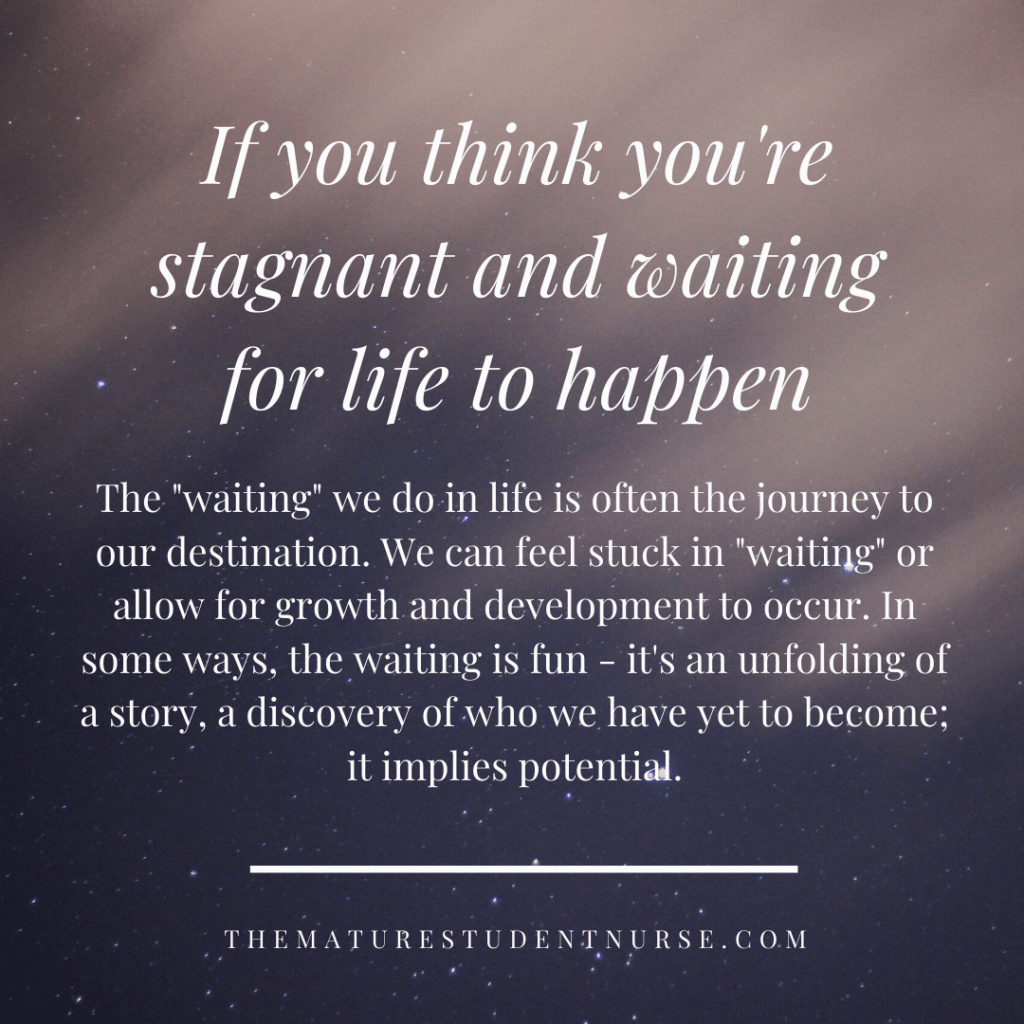
The “waiting” we do in life is often the journey to our destination. We can feel stuck in “waiting” or allow for growth and development to occur. In some ways, the waiting is fun – it’s an unfolding of a story, a discovery of who we have yet to become; it implies potential. If you ever think you’re stagnant and waiting for life to happen, know you’re not alone. I feel this way from time to time. Sometimes, we need a little reminder of the power we have over the choices we make. You are the only thing you can control, so set your priorities and do what you can to move towards your goals. Other times, we need a little encouragement. When I’m doing what I can but feel I am not getting the results as quickly as I want and start to doubt myself, I remind myself of the lyrics from “Wait for It”: “I’m not falling behind or running late. I’m not standing still – I’m lying in wait”.
A popular scrubs manufacturer released and took down an ad this week due to its controversy and social media backlash. The advertisement featured a female DO in pink scrubs reading a book, “Medical Terminology for Dummies” upside-down. I completely missed this ad until I saw a post by the medical blogger, @RealDoctorMike, criticizing the company: https://youtu.be/aqj7T-wes2c#WomenInMedicine
As a consumer, I realize where I spend my money makes a difference. Who and what I support with my purchases matter to me. I don’t have the opportunity to research all businesses I interact with, but I try to act according to my values when I’m informed.
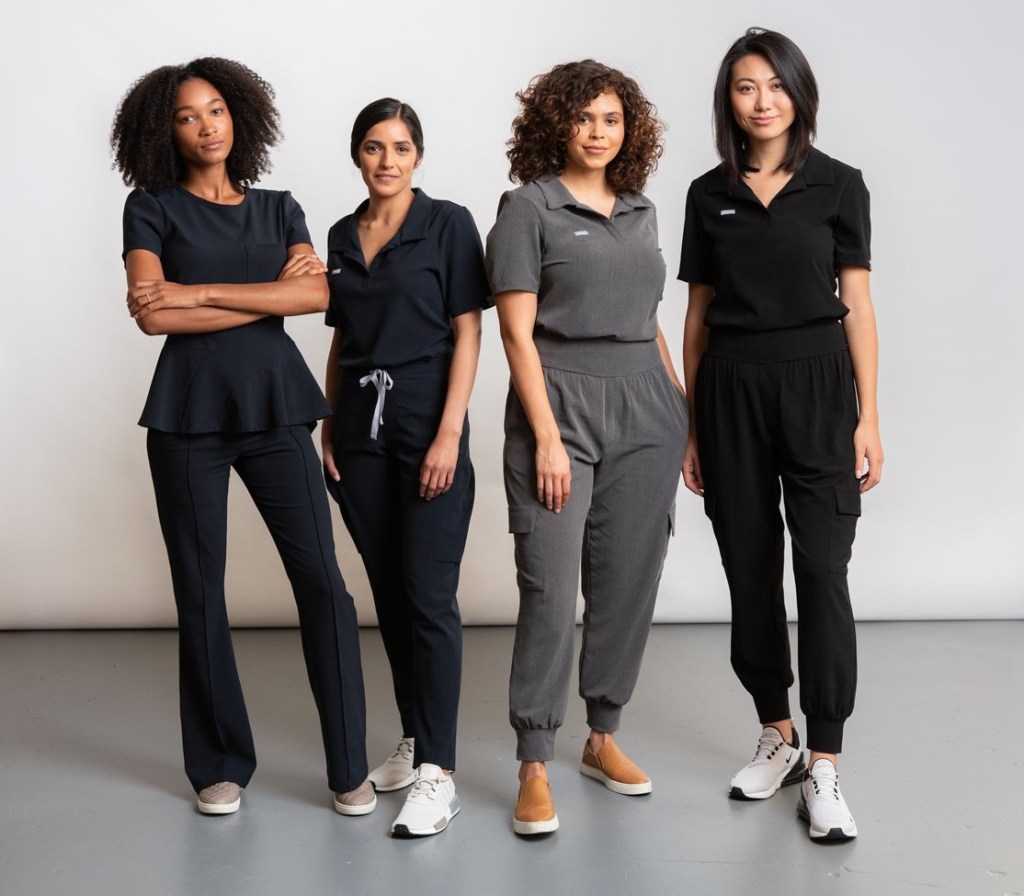
If you’re considering buying scrubs and want an alternative to the ones offered by the manufacturer who posted the inflammatory ad, consider Sway Scrubs. Sway Scrubs (swayscrubs.com) launched this year and is a female, Black-owned business. I have no affiliation with Sway Scrubs but have been considering purchasing their scrubs to support more minority-owned businesses. Plus, they have cute designs, so I’m eager to try them once I decide to buy more scrubs!
Image from swayscrubs.com
Since graduating from nursing school and looking for jobs, I’ve held off on buying more scrubs if my future place of employment has specific uniform requirements. I own two pairs of Code Happy scrubs outfits because that is what my nursing program offered. I’ve worn and would recommend Code Happy scrubs. I would purchase them again because they fit my short, stout body well, and the price was reasonable. I’m so vertically-challenged that when I order petite-sized pants, I usually have to alter them. I was honestly shocked that I didn’t have to hem the Code Happy petite pants – the drawstring waist and ankles make all the difference!
Below is a pic of me in my Code Happy scrubs during Nurse’s Week this past Spring. The hospital was celebrating healthcare workers as heroes – hence, the Wonder Woman statue in the back. Women in healthcare are heroes – many are pioneers or have had to endure extra criticism just because of their gender. Women in healthcare should be celebrated and respected. We need to encourage diversity in healthcare and recognize the importance of each team member in caring for patients or clients. Titles of DO, MD, RN, LPN, CNA, RT, Housekeeping, etc. should not change how others treat you. Titles may indicate the scope of practice and education, but it shouldn’t dictate how or if others treat you with dignity and respect. Also, an inclusive culture welcomes and encourages all genders into both medicine and nursing.
Here is a snapshot of me in Code Happy scrubs during an Advanced Med-Surge clinical. I liked how the Code Happy scrubs fit my hard-to-fit body, but I also liked all the storage. As you can see, I took advantage of all the pockets my scrubs offered!
Unfortunately, a favored scrubs manufacturer created an ad that belittled female healthcare workers and DOs. Thankfully, the company has since removed the ad, and hopefully, an educational moment occurred for the company and others. We all have biases, but our actions and lack of awareness may promote others’ disadvantage. We can evaluate how such prejudice affects others through the language and images we use and the businesses we support. Are we empowering others or tearing them down? Are we causing division or uniting others in healthcare? Are we supporting companies that align with our values? As I’ve yet to purchase scrubs beyond nursing school, I would love to hear your recommendations for scrubs or your experience with other scrub manufacturers!
….
Update: As soon as I posted this, I noticed @nurselifern pointed out the same company created a similar ad poking fun at male RNs. A male RN in one of their ads was also reading a “…Dummies” book upside down! I’m really shocked this wasn’t uncovered or discussed sooner. We need to support diversity and inclusion in healthcare! I’m amazed that a company that caters to healthcare professionals and relies on their support could spend time, money, and resources to insult and belittle them in their marketing campaigns!
*My imperfect attempt at lettering the title of this post. I could have spent more time making it pretty, but I would have never published my post. It would have been ridiculous and ironic to delay my post to make my lettering nicer, given my post’s subject, so I went with it.
I had my annual physical yesterday with my primary care physician, whom I’ve been going to for over 20 years. I like her because she takes time to talk to me and check in on my emotional and mental state rather than focus solely on my physical ailments. She was happy and excited to learn I had graduated from nursing school. She asked whether I planned to have more kids. I shared my anxiety over my ability to have another healthy child at my advanced maternal age. I started to talk about parenting and the guilt I feel about being an older mom to my daughter. She knows me well, however, and knows I can be overly critical of myself.
I responded that this was the problem with being a perfectionist; I recognize I can be needlessly hard on myself. She declared, “I want to eliminate the word ‘perfectionist.’ What if we replaced perfectionist with ‘overly critical’? No one wants to be overly critical!”
“What if we replaced ‘perfectionist’ with ‘overly critical’? No one wants to be overly critical!”
Dr. M
I tried to explain I am not proud to be a perfectionist and am trying to change. Still, I shared how my perfectionist attitude got me through pre-requisites and helped me complete a competitive accelerated nursing program. She shared how she can relate to this and proceeded to tell her story when she was younger.
When she was in medical school, residents were required to go to counseling. She met with the counselor, who eventually noted, “You have a harsh critic inside, don’t you?” The counselor encouraged her not to be so critical, “You don’t yell and scream at a two-year-old to learn their alphabet. You don’t yell and scream at a toddler to get them to walk. You don’t have to be so difficult on yourself”. My doctor defiantly declared to her counselor that she had no intention to change since her harsh critic served her well. My doctor rationalized to her counselor that she accomplished her goals and got to medical school because of her “harsh critic.” Her counselor responded that she didn’t do those things BECAUSE of her harsh critic; she completed those things DESPITE her.
I appreciated my doctor’s story because it paints an alternative to being “overly critical.” As a parent, I can relate to the patience and compassion needed to teach a child a new skill. I could scream and make my daughter cry about brushing and flossing her teeth, for instance, but there are other ways I can guide and encourage her. In the same way, I can choose different ways to talk to and motivate myself. I don’t have to suffer so much by my internal critic or be perfect to achieve my goals.
I have had to consciously and regularly examine the toll of aiming for perfection in nursing school. I shared how I would reason, “I could kill myself to get 100% on a care plan, or, I could spend more time with my family and get a 93%.” After hearing this, my doctor exclaimed, “Perfect is the enemy of good.” She echoed what I have struggled to remind myself over the years.
“Perfect is the enemy of good.”
Dr. M
There’s a book entitled “Good to Great” by James C. Collins that my pastor talked about during one of his homilies years ago. From it, my pastor learned and shared, “Good is the enemy of great.” I never got around to reading the best-selling book, but that message stuck with me: I would challenge myself to do better. I’d ask myself if my work or actions were the best I could do. At some point, however, I’d get discouraged and have an all-or-nothing attitude. If I couldn’t do things as well as I thought I should, I didn’t want to do it at all, or I’d scrap an entire project. I’d be ashamed of myself and compare myself to others. Striving to be perfect, I would feel frustrated, resentful, and spent. However, years since that homily, I’ve often thought, “Perfect is the enemy of good enough.”
While I do not advocate living one’s life by always doing only the bare minimum, sometimes the bare minimum maintains my sanity. “Good enough” has allowed me to survive and move forward from perceived failure. I’m learning to ask myself more often, “What’s it going to take?” and “Is it worth it?” (like in writing dreaded care plans) or “How can I approach this without so much suffering”? I still need reminders to be gentle with myself and that not everything has to be perfect to be great, so it was nice to hear my doctor affirm my previous thought.
I appreciated my doctor taking the time to remind me: perfect is the enemy of good. No one is perfect. Humans are imperfect and fallible, and it’s our struggles that lead to our growth…And sometimes, “good enough” is pretty frickin’ remarkable.
Last week, the world discovered that Chadwick Boseman, an actor best known for portraying The Black Panther, died at the age of 43 after a 4-year battle with cancer. He played a superhero and legends on the screen, but as we learn more about him and his life, we realize he was a heroic icon himself. While he battled cancer and underwent treatments, he visited sick children in hospitals and continued to film movies without revealing his illness.
Chadwick Boseman used his gifts and talent to make a positive impact in the world. He found his purpose and pursued it with a passion. Below is an excerpt from a 2018 commencement speech he gave at Howard University where he speaks about his struggles in pursuit of his purpose (the full speech can be found at Howard University’s channel on YouTube)…May Chadwick Boseman’s life and words inspire you to think about your purpose and your own pursuit of using your talents and gifts to best serve the world.
“Sometimes you need to feel the pain and sting of defeat to activate the real passion and purpose that God predestined inside of you. God says in Jeremiah, ‘I know the plans I have for you, plans to prosper you and not to harm you, plans to give you hope and a future.’… when you have reached the hilltop and you are deciding on next jobs, next steps, careers, further education, you would rather find purpose than a job or career.
Purpose crosses disciplines. Purpose is an essential element of you. It is the reason you are on the planet at this particular time in history. Your very existence is wrapped up in the things you are here to fulfill. Whatever you choose for a career path, remember, the struggles along the way are only meant to shape you for your purpose. When I dared to challenge the system that would relegate us to victims and stereotypes with no clear historical backgrounds, no hopes or talents, when I questioned that method of portrayal, a different path opened up for me, the path to my destiny.
When God has something for you, it doesn’t matter who stands against it. God will move someone that’s holding you back away from the door and put someone there who will open it for you if it’s meant for you. I don’t know what your future is, but if you are willing to take the harder way, the more complicated one, the one with more failures at first than successes, the one that has ultimately proven to have more meaning, more victory, more glory then you will not regret it. Now, this is your time. The light of new realizations shines on you today. [Howard’s] legacy is not wrapped up in the money that you will make but the challenges that you choose to confront. As you commence to your paths, press on with pride, and press on with purpose”.
Chadwick Boseman, excerpt from 2018 Howard University Commencement speech
RIP, Chadwick Boseman. We are thankful you pursued your purpose, inspiring generations.
Many people, even non-nursing professionals, have heard of famous nursing pioneers such as Clara Barton, founder of the American Red Cross, or Florence Nightingale, considered the founder of modern nursing who was also known as “The Lady with the Lamp” (her moniker, since she would administer to hospital patients at night with her lamp). During a recent lecture, however, my professor asked the class if we had heard of nursing pioneer, Mary Seacole. None of us had. Apparently, Mary Seacole was a nurse of Creole descent who also nursed wounded soldiers during the Crimean War, during the same time as Florence Nightingale. Supposedly, Mary Seacole’s fame rivalled that of Florence Nightingale during the Crimean War, yet not a single one of my 28 other classmates ever heard of Mary Seacole.
Mary Seacole was a Jamaican woman who came to London with a desire to volunteer as a nurse and be recruited as part of Nightingale’s delegation of women to serve as nurses in the Crimean war. Mary Seacole was instead met with racism and was refused the opportunity to serve as one of Nightingale’s nurses. Mary Seacole, therefore, independently traveled to the Crimea to establish and fund her own hospital, the “British Hotel” and tended to sick and wounded soldiers. She wrote an autobiography describing her experience as well as personal travels, “Wonderful Adventures of Mrs. Seacole”.
Mrs. Seacole was a woman who was undeterred and forged forward doing what she was called to do, to be a nurse, despite the racism and other obstacles she encountered. After hearing a bit about her from my professor and googling more about her, I decided to put her book on my wishlist and received it as a gift on my birthday a couple weeks ago. Aside from my textbooks, I’m glad to add this to my library of nursing books alongside my “Notes on Nursing” by Florence Nightingale.
While overwhelmed with school works and projects, I felt compelled to start reading and learn more about this woman. I kept meditating on the fact that I never heard of Mary Seacole, or didn’t really know of any other famous or pioneer nurses of color. It bothered me because, prior to the recent Black Lives Matter protests, I also had never heard of “Black Wall Street” or the “Tulsa Massacre”. I’m a person of color, born in Kansas City, Missouri and raised in a suburb of Kansas for my childhood. I did not grow up in a diverse area and was typically one of only a handful of minorities in all my schools. Now that I’m an adult, I realize there are gaps in my education – history, in particular – that exist due to the omission of the non-white perspective.
I’m grateful to have the opportunity to have professors offer different perspectives and illuminate the history of nursing and nursing pioneers beyond “The Lady with the Lamp”. We need to celebrate and encourage diversity in Nursing. I feel that one step towards cultural competency and addressing racism in healthcare is to take time to hear different voices and promote diversity in healthcare. This also allows me to draw from a richer well of people to inspire me to move forward in nursing, despite obstacles I might face. I encourage you to move forward, seek different voices, take action, and draw inspiration from where you find it, too.
I attended my first parent-teacher conference this week for my preschool daughter. I had wrapped up my final exams just two days before. While my own grades were still unknown, my husband and I learned about my toddler’s progress and “grades”. We got a snapshot of where she was as far as cognitive skills, emotional development, gross motor/fine motor, and social skills. My daughter’s ratings were “P”, “B”, or “D” for her various skills.
I asked the teacher, “What do the letters mean?”
She replied “P is for proficient. B is for building”.
I then inquired, “Is D for deficient?”
She said with a laugh, “No, D is for developing.”
In a prior Facebook and Instagram post, I shared how a professor described my “deficiency” after a clinical simulation and provided solely negative feedback to me. I was unexpectedly triggered by my own insecurities at my daughter’s preschool review, thinking “D” meant “deficient” for areas where she could use more work. Instead, the areas where she could improve are ones in which she is still “developing”. What if I gave myself the grace and focused on how I am still developing? What if I transformed “deficient” to “developing?” Stating, “I’m developing a skill” elicits a very different response and attitude from, “I’m deficient in a skill.”
What if I transformed ‘deficient’ to ‘developing’? Stating, “I’m developing a skill,” elicits a very different response and attitude from, “I’m deficient in a skill.”
The Mature Student Nurse
I got emotional during the conference and started to cry. I cried at the recognition of myself in my daughter. I cried about projecting myself on her progress and development. In a moment, I felt my issues had me resigned to suck at parenting. The traits and behaviors I notice in myself that I try to “fix” or change show up strongly in my daughter: stubbornness, perfectionism, and inflexibility.
She may give up on doing something if she notices she is not doing it perfectly.
She was doing a cutting exercise with scissors but just gave up and decided not to do it because she saw she wasn’t exactly following the cutting line.
I have multiple calligraphy sets that I don’t use because I get discouraged with how my writing ends up looking – even though I know the whole point is to practice.
She can be very driven and direct herself, but so much so where she does not welcome working in teams.
She loves working on puzzles by herself, but she gets upset when her classmates try to join her.
I sometimes find it challenging working on group projects. I dread them at times.
She can fixate on things and become emotionally derailed if things do not go as she planned.
She melts down over clothing.
I go into panic mode over a bad test grade.
She gets an all-or-nothing attitude.
She was supposed to draw a picture of herself. She started, but was unhappy with how it turned out. She erased the image and tried to re-draw the picture, but never finished.
Because I want to do things perfectly, I can take a long time doing things or worse, I won’t do it at all.
I realize my daughter will naturally take on her parents’ traits – good AND bad, whether we purposefully do this or not. How can I expect her to act differently when I do not know how to do this for myself? How can I give her tools I do not have? To an extent, I realize my stubbornness and perfectionism has served me well and allowed me to get into a very competitive nursing program. However, I also recognize where it has not served me.
I’ve heard the saying, “the enemy of great is good enough,” but I know my issue can be summarized as “perfection is the enemy of good enough.” I can get overwhelmed or paralyzed from not being able to do things perfectly or exactly the way I think I should. Comically, I now recognize that my perfectionism is what had me put so much pressure on myself as a parent that I was driven to tears at my daughter’s parent-teacher conference.
I would not want to label my daughter as “deficient,” so why am I so quick to label myself this way? My daughter is DEVELOPING. So am I.
The acknowledgement that I am still developing is a gift and empowering. I can work with that. If I want my daughter to know that it is okay to make mistakes and pursue projects imperfectly, I need to demonstrate that. Before I can change my behavior, I need to notice it. I see how my behavior impacts my life (and my daughter’s). I can do something about it now that I recognize it. I am figuring it out as I go along. I feel lost at times and may not make the best choices, but I’m trying – I am still developing.
I went to church Sunday morning with my family and saw the devotional booklet “Our Daily Bread” offered in the vestibule. I hadn’t seen one in a while, but became familiar with them through my mother and relatives from the Philippines, who used them regularly as a daily devotional. The booklet highlights a bible scripture each day and provides a reflection based on that reading. Feeling like I needed to focus more on my spirituality beyond church (it’s so hard sometimes to focus in mass with a rambunctious defiant toddler!), I grabbed one. The bible passage and reflection for that day (April 28, 2019) spoke to me. Because of that, I wanted to share it and invite you to read it at https://odb.org/2019/04/28/gods-retirement-plan/# .
At this moment in your life, what might God be calling you to do for His greater purpose? What new plans has He placed in your path?
Our Daily Bread (April 28, 2019)
The reflection was a great reminder of my second-career journey. Becoming a nurse is the new plan God has placed in my path. I feel I am called to become a nurse to better utilize my talents for His greater purpose. Do you ever feel like you’re on the right path because of the all the “signs” God places before you? You may not have the sign of a burning bush like Moses, but do you feel called to do something, even though you’re uncertain of how exactly you’ll accomplish what you sense you must do? Are you continuously driven towards a vocation without knowing how or if you can really make it happen? And, somehow, a path reveals itself? I feel this way about Nursing – really, I do!
Every step of the way, I feel like God has aligned things for me to allow me to get into Nursing school. If I had waited even one month to look into pre-requisites, I wouldn’t have been able to take the classes I did or complete them before the application cycle. If I had waited one week before researching how to get volunteer clinical experiences, I wouldn’t have become a COPE Health Scholar in a local hospital. If I were in a different volunteer program, I wouldn’t have been able to take patients’ vitals, witness biopsies, circumcisions, C-sections, vaginal deliveries, or perform chest compressions on patients who have coded. God placed people and experiences in my life, to allow me to grow in my compassion, abilities, and skills as a future nurse. Somehow, things aligned or confirmed and re-affirmed my choice to purse a career change. God placed the desire in my heart to consider nursing years ago, but He did not call me into action until now -when I have the social, emotional, and financial support I didn’t have before. His timing was perfect. I prayed to be able to serve God in whichever way He willed, and nursing is where I have now been lead. I have a peace and joy in my heart when I think about my [future] career, but I am still open to God’s vocational plans for me in my life.
Are you called to something new or to continue when you were about to quit? I encourage you to be open to new possibilities or to where God might be calling you. Explore what or where that is, and if you’re called to act, pursue it whole-heartedly. Like Dr. Warwick Rodwell discovering the ancient statue in the Lichfield Cathedral in the “Our Daily Bread” reflection, you could be surprised with the treasure you uncover.
I want to share a prayer/meditation a dear friend shared with me, right before she told me she would change career directions from Law to Medicine. This prayer/meditation, “Your Heart’s Desire” helped motivate her as she discerned moving and leaving Southern California to attend medical school in Poland. I love this prayer/poem, but neither my friend or I know who wrote it.
“Your Heart’s Desire” is inspiring and speaks to the idea that we all have a calling in life. Your “vocation” might be your occupation or profession, but per its Latin roots, your vocation is also your “calling” or your “summons” in life. I feel like this calling to become a nurse was clear for me only recently – it could have been God’s timing or perhaps my stubbornness and inability to listen – but I truly feel called and drawn to nursing after many years of working as an engineer. Maybe I needed to fulfill my calling to become a wife and mother before becoming a nurse, who knows? Either way, I hope you enjoy this prayer/meditation and that maybe it speaks to you, too:
“Already in your past life from time to time, God has whispered into your heart just that very wonderful thing, whatever it is, that He is wishing you to be, and to do, and to have. And that wonderful thing is nothing less than what is called Your Heart’s Desire. Nothing less than that. The most secret, sacred wish that lies deep down at the bottom of your heart, the wonderful thing that you hardly dare to look at, or to think about–the thing that you would rather die than have anyone else know of, because it seems to be so far beyond anything that you are, or have at the present time, that you fear that you would be cruelly ridiculed if the mere thought of it were known–that is just the very thing that God is wishing you to do or to be for Him. And the birth of that marvelous wish in your soul–the dawning of that secret dream–was the Voice of God Himself telling you to arise and come up higher because He had need of you.”






 The Mature Student Nurse