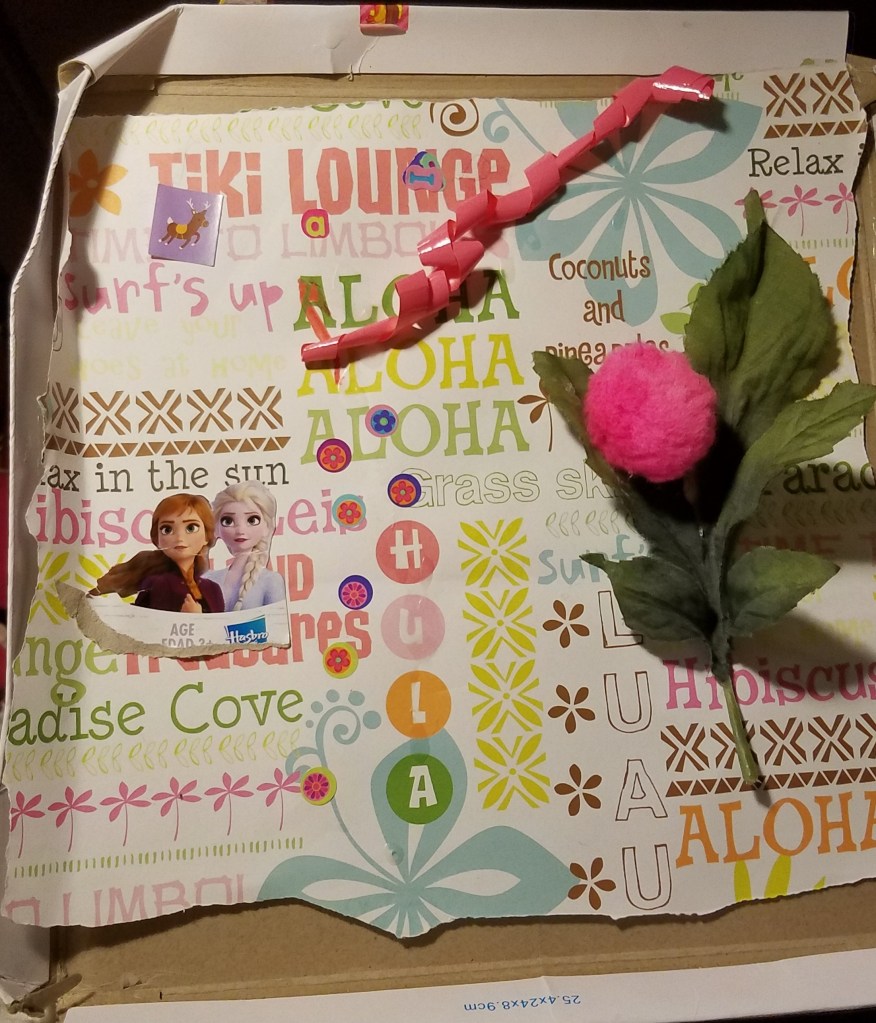
Due to an unexpected quarantine from my daughter’s exposure to a COVID positive person, I found myself stuck at home for two weeks in January with my husband and daughter. Thankfully, all of us remained asymptomatic and tested negative for COVID. However, I adhered to the health recommendations to quarantine, and I did not work or leave the house outside of medical appointments for 14 days. Homebound, I decided to make my 2021 vision board a fun, creative activity I could do with my daughter.
Below is the result of crafting together that day.
My vision board / collageMy preschooler’s collage
I tend to be a visual learner and have found vision boards to be powerful tools. I’ve shared this before, but years before I became a mom, I made a vision board about being a parent. My husband and I spent over a year trying to get pregnant before I had a miscarriage. I eventually became pregnant with my daughter almost a year after our loss. It was pretty amazing to look back at that vision board, even though my dream of motherhood took some time to materialize.
If you want to try your hand at making a vision board, below are some tips:
Review your goals or vision board from the prior year (or semester or quarter). Reflect on what you’ve accomplished and acknowledge your achievements!
Do you have any remaining goals that will continue into the next year (or another timeframe)? Do you need to remove some obstacles before you’re able to achieve these goals? Consider removal of a barrier to be an initial goal.
Think about your goals for your specified timeframe (year, semester, or quarter). What plans do you have for various areas of your life? You can focus on several areas of your life or many, but here are some to consider: work/career, finances, personal relationships, health/fitness, spirituality/well-being, education & development, rest & relaxation, or hobbies & fun.
Are your goals S.M.A.R.T. ? S = Specific, M = Measurable, A = Achieveable, R = Realistic, T = Time-bound. If not, design them to be S.M.A.R.T.
After you’ve thought about your goals (I also recommend writing them down in a planner or calendar!), gather supplies: paper, scissors, tape, glue, markers, and items with images you can use in your vision board (magazines, calendars, catalogs, or Pinterest photos/pins).
Start cutting out and collecting images or words that inspire you or remind you of the goals you have set for yourself.
Get at least one photo of yourself to place on your vision board. I also included pictures of my family in mine.
Assemble your vision board, making sure to include the year or goal timeframe (e.g. Semester I 2021) and a photo of yourself!
Place the vision board in an area you frequently see. I made my 2020 vision board and hung it on the wall by my desktop all last year. I replaced it with my 2021 vision board this month.
Before I made my 2021 vision board, I reviewed my 2020 vision board (per step 1 above). I posted my board last January on my FB and IG pages:
Upon review of last year’s vision board, it was reassuring to see how many things I accomplished or goals I achieved, despite a worldwide pandemic and various stay-at-home orders:
The photo of a mom and her newborn in my vision board was a nod to my much-anticipated maternal newborn and pediatric rotations. I got to attend an emotionally moving c-section birth as part of my maternal newborn clinical rotation last year. My classmate and I witnessed a father cry with overwhelming joy and love for his newborn child – it was so sweet that my classmate and I were both moved to tears. I got to complete my preceptorship in a NICU. I had wonderful experiences during my rotations.
I had a bunch of images related to nursing, education, and graduation. I graduated from nursing school with my BSN and passed my NCLEX last year.
I have “RN” and a pile of money on my board. I started my first job as a Registered Nurse before the year ended.
I have travel luggage, a camera, vacation views, and photos of families having fun doing various physical activities on my 2020 board. My family and I managed to squeeze in two family vacations last year – one to Solvang (thanks to a good friend’s timeshare) and another to Bishop (as a result of tagging along on my husband’s business trip). We did not travel the way I originally envisioned after graduation, but my family enjoyed ourselves and explored new places while safely adhering to health orders.
I have images from “Hamilton”, the musical. I had tickets to watch the musical in-person with my husband at the Pantages in May. The show was canceled due to the pandemic. Luckily, our theatre tickets were refunded. I had to be satisfied (but “I will never be satisfied!”, a la Angelica Schuyler) watching it on Disney+. A benefit with watching the musical at home is that my daughter gets to enjoy it, too. My daughter periodically requests Alexa to play the songs, particularly the ones sung by any of the Schuyler Sisters.
Before the pandemic, I was excited to be part of the graduating class of perfect vision, 2020. I remember being a total dork and declaring this to my classmates well before the pandemic became a reality. After the pandemic started, I forgot about being part of the class of perfect vision. Earlier this year, however, my church’s mothers’ ministry had a Zoom meeting challenging members to think about how 2020 was the year of perfect vision. It was interesting to consider: I had to be laser-focused in my commitment to my goals to avoid distractions and overcome the obstacles of an unexpected pandemic. And maybe 2020 had me re-focus and let go of attachments and what I thought my life should look like. My family did not travel to other states or countries for vacation as in previous years, but we got to experience adventure and explore new places locally and within the state. My daughter speaks fondly of Solvang as much as she does of Spain (we visited in 2019). Even with letting go of attachments and expectations of what I thought things should be like, I didn’t accomplish all my 2020 goals – I still need to add more physical activity in my life and to declutter my home – but looking at my old vision board, I’m proud of what I’ve accomplished in 2020! Now, onward to 2021!
Some of you might be applying and preparing for nursing school interviews. December is when I began my nursing school interviews a couple of years ago. Out of the schools to which I applied, only two required in-person interviews as part of their application process. Luckily, I wasn’t a stranger to interviews by that point. Before nursing school, I interviewed for a competitive clinical volunteer program and eventually helped interview and screen applicants when I became a leader. It seems to be that time of year again for interviews because I landed my first new grad RN interview this past week for a local hospital. Since it appears to be interview season for myself and others, here are some of my suggestions for interviews, based on my experience and advice from friends and professors. They include anecdotes of my interview blunders, so you hopefully learn from my mistakes!
Research the organization by reviewing its website and doing an internet search. You can research companies and hospitals and see what their current and former employees have to say about them on Glassdoor.com.
Review mission statements. What can you share about yourself that matches or aligns with their mission statement?
If you know any current or former employees/students, ask them about the unit, program, or culture.
Doing this research will help you prepare a more specific answer to the interview question, “Why do you want to be part of this school/hospital/unit/organization?” You’ll also be able to find information about considerations you might have to reduce the number of questions you ask during your interview.
Anticipate the questions and prepare your answers
Be prepared to answer questions from your application essays and be able to speak to your resume. You should be able to discuss or explain anything you have provided in your application. Be prepared to talk about yourself and give them an idea of who you are. Interviews with nursing school, volunteer programs, or entry-level positions do not typically ask many technical questions – people want to learn about YOU. (Although, I did have a couple of clinical-type questions in my latest interview).
What I found interesting is that nursing school interview questions were not much different than job interview questions or even questions from my volunteer program. Below are some common questions one should be prepared to answer or discuss during an interview:
Tell me about yourself
Why did you become a nurse? or Why do you want to be a nurse?
Why do you want to be part of this school / hospital / unit / organization?
Why do you want this position?
What are your strengths?
What are your weaknesses?
Tell me about a time you made a mistake.
Tell me about a time you managed a challenging situation or overcame a challenge.
Describe a time you had a conflict or disagreement with a colleague.
What do you have to offer? / What makes you different from other candidates? / Why should we hire you? / What can you bring?
What would you do if you had a difficult or agitated patient?
What would you do if you had a difficult preceptor?
Where do you see yourself in 5 years? 10 years?
Do you have any questions?
For my volunteer program and nursing schools, other questions I encountered were:
How have you prepared for this program?
How have you ensured your successful completion of this program?
Finally, for additional interview questions, there are some great ones listed online. I found other nursing school interview questions at https://allnurses.com/common-nursing-school-interview-questions-t553788/. I looked at job applications for new grad programs, even ones to which I wasn’t applying, and I pulled some of the following questions from an application:
What academic, clinical skills, and personal attributes do you have that will enhance your success in this program and your professional role as a nurse?
Cultural competence and respect for others are important in nursing practice. Describe a few ways that you have incorporated cultural sensitivity and competence into your own nursing practice.
Please briefly describe your professional/career goals.
Allnurses.com also has forums for people applying to specific nursing schools or hospital new grad programs – the discussion boards usually give you an idea of interview schedules, formats (in-person vs. virtual), or questions. When applying to specific programs, it’s helpful to know if candidates are already interviewing to assess if the program is still considering your application. It’s also good to keep in touch with your cohort after graduation for this same reason. My classmates received interview invitations and job offers to join a new grad program I applied to, while I heard nothing. It took over a month to receive my official program rejection, but I anticipated it since my classmates had interviewed for the same program a month prior.
One of my friends recently finished her first year and a half working as a nurse and interviewed for a new RN job. She shared possible interview questions with me. For more seasoned nurses, a potential employer may ask the following questions:
What do you look for in a leader? How do you emulate that?
What do you like about nursing? Dislikes?
What do you find rewarding about this profession?
How do you deal w/someone unsatisfied w/ your care?
Tell me a time about a clinical emergency and how you reacted.
Tell me a time you had to deal w/ difficult MD.
Here’s another great interview question I found in a Facebook group: Tell us about a time you had an error in judgement. What happened, what did you learn, and how has this shaped you into the nurse you are today?
Practice and use prompts
One interview preparation technique my friend used was to write out her responses to potential interview questions. She placed the questions and notes about her answers on the wall behind her computer and camera. During her virtual interview, she was able to glance at her notes, when needed, to help her answer questions. I think this idea is genius!
I do not recommend reading word-for-word written answers to interview questions. However, writing answers may help clarify what you want to convey about yourself or allow you to draw upon stories and examples to share more readily. I love my friend’s technique because little notes or prompts help prevent blanking out during an interview. This technique is similar to giving speeches or presentations: Never recite notes or slides, but use them as prompts to remind you what to say or share.
After writing out your responses to potential interview questions, practice sharing your answer out loud. Practice with yourself in a mirror, and later, practice with another human being. I am planning to do this with friends and former classmates. Mock interviews serve as dress rehearsals and allow for feedback for improvement and adjustments before actual interviews.
For my clinical volunteer program, applicants were instructed to dress professionally for their interview. I dressed in business casual clothing and opted not to wear a blazer. It wasn’t until I became a leader that I discovered that they docked points for applicants not wearing a blazer or suit to their interview. After learning this, I made sure to wear a blazer (or business suit) during future clinical interviews.
The following year, for one nursing school interview, I spilled tea all over my blazer as I drove to the interview. I set my tea on the passenger seat (it didn’t fit in the cup holder), and somehow my tumbler tipped and spilled its entire contents onto my blazer resting below it. Luckily, my blazer was black, and it was difficult to tell it was even wet. I dried it as best as I could once I arrived and parked at my interview location. I was able to wear my blazer during my interview, even though it was damp. It just smelled fragrant – like lavender earl grey tea! My lesson from this is never to drink colored beverages going to an interview and maybe carry a Tide pen!
For nursing job interviews, job applicants typically do not wear scrubs to an interview unless they arrive directly from a shift or are interviewing during a break in their workday. If you’ll need to wear scrubs to an interview, explain that to your interviewer beforehand.
Bring copies and material for notes
For your interview, bring extra copies of your resume or your nursing portfolio to share with interviewers. Bring material (ex. pen, blank paper) to take notes. Collect the contact information or business cards of your interviewers.
Arrive early enough to park and walk to your interview! Unfortunately, I was about a minute late to my top choice nursing school interview. I arrived at the interview location 40 minutes early but was unable to find parking. I had been to the site twice before and easily parked at the adjacent parking structure both times. I thought arriving 40 minutes before my interview would give me extra time to park elsewhere on campus if needed. I was wrong.
All lots, even the farthest ones on campus, were full. It was raining and a Tuesday of the first week of the semester; most students were attending class or petitioning themselves in courses. I drove around multiple times and tried parking on all parking lots listed on the campus map. I even went through the nearby neighborhood, but the residential area required permits to park. I finally found street parking outside a restaurant blocks from the campus beyond a freeway entrance. Only 60 minutes of parking was allowed per street signs, but I was willing to take my chances. I could go over a little time and possibly get a parking ticket over missing my interview at my top school!
After I parked, I ran as quickly as possible and called my interviewer to let her know I was on my way but running late. I arrived at the front office out of breath and wet from the rain. Fortunately, I was only a minute late, and they allowed me to interview. Lucky for me, that school accepted me into their program!
These days, because of the pandemic, many interviews are done virtually. Get yourself set up early enough to allow your computer to load, log in to the program used for the interview, and be comfortable. Make sure the background the interviewer is seeing is free of mess and clutter or anything distracting. A trick an old co-worker of mine used was to ensure she seated herself in front of a wall of her awards and certificates during a virtual interview. If you have a place where you hang your diploma(s), awards, etc., consider that wall as your background.
Be confident and calm
If you’ve prepared for your interview, you should be confident. You have made it farther than other candidates by even getting offered an interview! If you don’t feel confident or are anxious for your interview, practice slow deep breaths. Inhale over 4 seconds, then hold your breath for 4 seconds. Exhale for 4 seconds and hold your breath for 4 seconds. Repeat this breathing pattern to calm yourself. (I learned this breathing exercise from a live talk from Brene Brown, but I guess this is something first responders also practice)!
Hopefully, you arrived to your interview early. Go to a restroom beforehand, look at yourself in the mirror, compliment yourself, and practice wide-stances. Put your hands on your hips. Keep your back straight, shoulders back, and chest up. Make sure you are not physically sinking inward, which can give the impression of insecurity. Do your pep talk and superhero wide-stance practice immediately before your interview. (I learned this superhero confidence-building trick during a training workshop in my previous job). During the interview, remember to look your interviewers in the eyes as you talk to them.
Ask Questions
If you’ve done your research, but you still have questions, make a list and bring it to your interview. The interview also allows an applicant to discern if a position or organization is right for them. “Do you have any questions?” is a common question asked at the end of an interview. When prompted, you can draw from your list of questions.
Below is a list of possible topics one could consider before or during an RN job interview. Ideally, you would research these topics ahead of time and discover most of the answers before your interview. Some job considerations are from my friend while others are from a nursing school professor:
Training process?
Scheduling?
Performance expectations?
Employee performance review process?
Support in education? CE? Conferences?
Opportunities to teach/mentor?
Involvement in shared governance
Why do you like working here?
Work environment?
Is this a magnet hospital?
When was your last accreditation? May I see the report?
Is this physical facility a place where I’d want to seek care?
Take a tour to see staff working. Are they happy?
Ask to visit unit(s). Observe the number of patients per RN on the board.
What are the benefits?
Is a contract expected?
When are people eligible for raises?
When does vacation start accruing?
Is childcare available or offered?
Meet with staff who will be in charge of you.
Are nurses allowed to do advocacy?
Is quality improvement top-down or driven by nurses? Do nurses drive performance improvement?
If in a clinic, is the medical director strong and stable?
What is nursing turnover like in the unit?
Care coordination?
Do finance people speak same language as nurses? What are their priorities?
What partnerships does the nursing departement have with patient families? What resources are available across the continuum and community?
Some questions to consider asking during nursing schools interviews are:
What is the NCLEX pass rate of your graduates?
How do you prepare your students for NCLEX? Are students required to do HESI or ATI or purchase UWorld?
What is the rate of people graduating in the recommended timeframe? How long does it typically take for people to get their degree in this program?
What is the clinical and lecture schedule?What is a typical day like for your students?
What is the size of the cohort?
What are the traits or practices of your most successful students?
What are the hospitals or clinics where clinicals have been held?
Are there student or faculty mentors?
Do you help with job search or placement?
How quickly do your graduates find jobs after graduating?
Where do your graduates typically work?
Write Thank You Notes
After your interview, write thank you notes to your interviewers. (You collected their contact info. during the interview, right?) Reiterate unique traits and strengths or clarify any uncertainties about yourself. You want to do this to be memorable and to give your interviewers confidence in choosing you. Express your gratitude and appreciation for the people that took the time to interview you. Emailing the thank you messages ensures quick delivery.
I wrote this blog post as a resource for others but also for myself. I need these reminders, too! I like that I can now review this list before every nursing interview. Do you have interview questions to share or tips to add? I would love to hear them!
Thank you for reading! If you found this post helpful or appreciate anything from it, please like and share with others! Good luck to you and your endeavors, and good luck with your interviews!
Thanks to an upsurge in COVID cases in Southern California, we have new stay-at-home orders in effect starting today. The Health Department does not recommend co-mingling or going to parks with other households. Playgrounds have shut down again. Dining at restaurants – even outdoors – is not allowed. As a parent, it’s sometimes hard to explain the changing rules to my preschooler. I’m a nurse trying to adhere to public health orders, but I’m also a concerned wife, daughter, and mother who wants to protect my family and loved ones from COVID. I found some complimentary child-friendly resources that explain COVID, hand-washing, mask-wearing, and social distancing. I’ve used them with my daughter and thought I’d share them here.
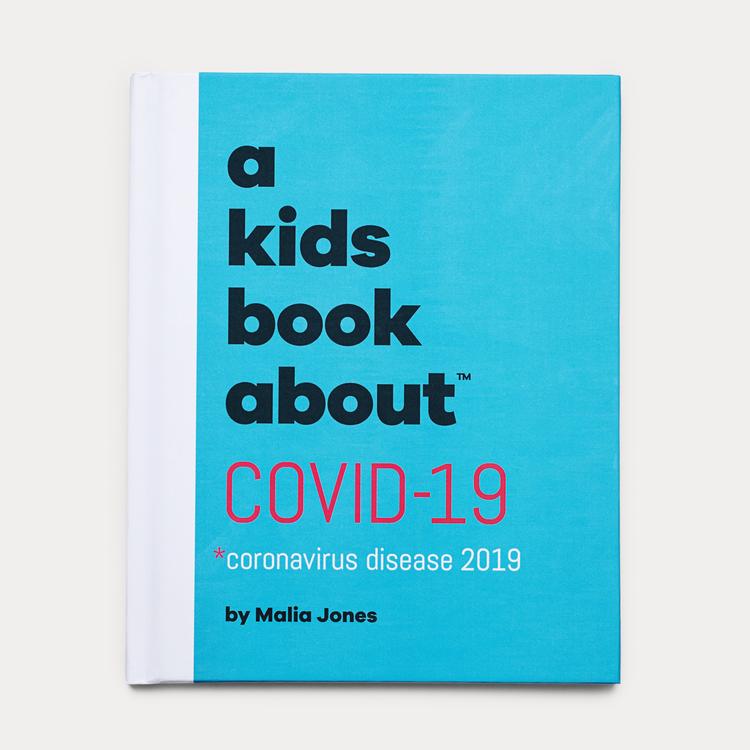
At the beginning of the pandemic, the series of books “A Kids Book About”… offered a free e-book “A Kids Book About Covid-19” by Malia Jones. It is still available for download here: https://akidsbookabout.com/products/a-kids-book-about-covid-19. My daughter and I read the e-book together, which helped her better understand social distancing and hand hygiene. (“A Kids Book About” offers other great books that help discuss complex topics such as death, cancer, and racism with children. I encourage other parents to check out the series)!
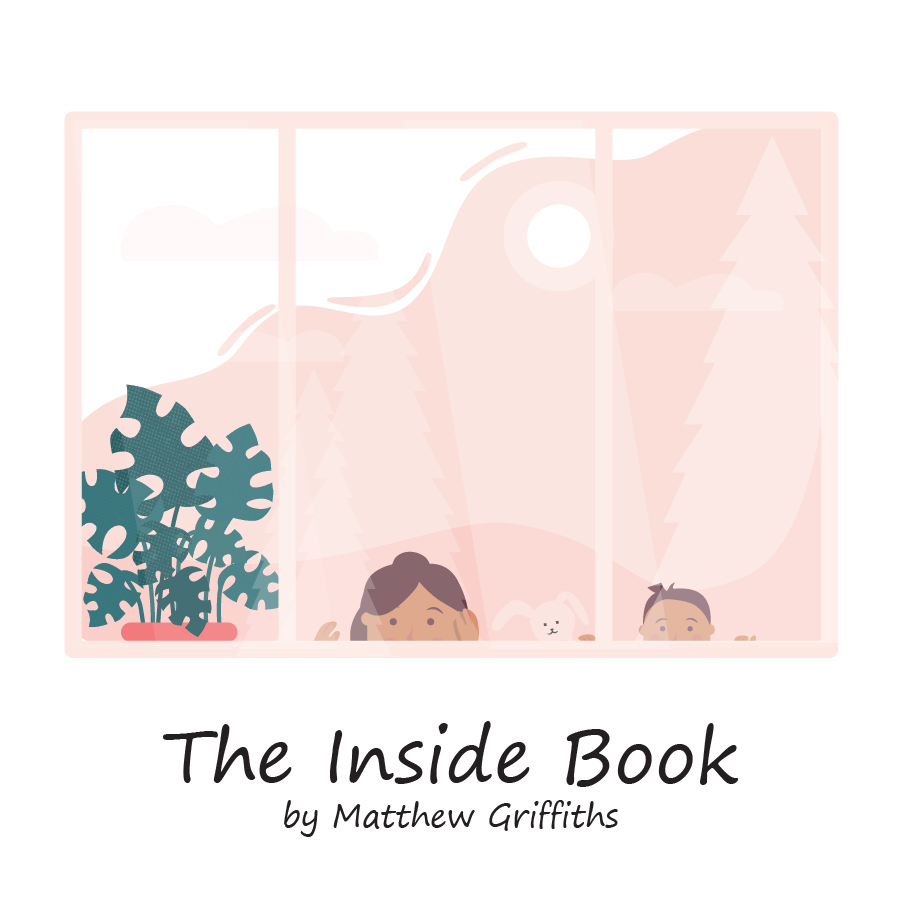
Another great book, also free, is “The Inside Book” by Matthew Griffiths. There’s graphics at the back of the book explaining handwashing, mask-wearing, and how to cover a cough or sneeze. This book is offered as a free download in various languages on the author’s website, https://mattcgriffiths.com/. There’s also an animated reading of the book at the same website and on YouTube.
On YouTube, the Dr. Binocs series offered by Peekaboo Kidz helps explain coronavirus and other science-related topics. (I discovered the series when I tried looking for kid-friendly information about pinworms. There was a pinworm outbreak at my daughter’s school a year ago, and I couldn’t find any preschool appropriate resource to explain it to my daughter)!
Life is hard enough to navigate during a pandemic. As a parent, it’s nice to have free tools to explain this pandemic and public health recommendations to my daughter (or younger patients)! I think these free resources above would be great to use for pediatric patient education. If you have other pediatric resources you use, please share! I would love to learn about them! Stay healthy and safe, friends!
For Christmas last year, I bought tickets for my husband and me to watch the musical “Hamilton” in Los Angeles during my semester break scheduled in May. I figured it would be a nice treat for us before my last nursing school semester. That was until the pandemic hit and canceled the show. While I was disappointed, I agreed with the CDC recommendations and state orders not to have large indoor gatherings. I figured I had already waited years to watch the show; I could wait a little while longer to enjoy it safely at a later time.
Once summer arrived, I was excited to learn that I could watch “Hamilton” from home on Disney+. However, I didn’t allow myself to subscribe to the streaming service until I graduated because I didn’t want to become distracted from studying. As a mini graduation gift to myself, I subscribed to Disney+ to watch “Hamilton” in August.
I know I’m years behind, but I finally watched and loved the musical, “Hamilton”! My preschooler has grown to love it too and will ask to play songs from the musical. She loves and will continuously replay the “The Schuyler Sisters,” “Satisfied,” and “Helpless.” Personally, “Wait for It” appeals to me. While “Wait for It” is the song of the musical’s anti-hero, Aaron Burr, I can identify with the feeling of waiting.
My favorite part of the song, “Wait for It” from “Hamilton”
Waiting to take the NCLEX
Life after nursing school requires a lot of patience. It’s almost anti-climactic to spend all this energy in an accelerated nursing program and graduate only to wait in what feels like forever to get permission from the nursing board to take the NCLEX. While other classmates’ accounts showed they conferred their degree soon after the semester ended, I had to wait for my transcripts to show I graduated weeks afterward. About a month after graduating, some of my classmates sat for their NCLEX; I still hadn’t received my authorization to test (ATT) from the testing company. I grew anxious and started to feel like I was on hold, waiting for my life to begin while everyone else was moving forward. I had to remind myself that my life was already in motion, and I had accomplished many of my life’s goals. I could choose to be content with my life as it was or wait for some external factor (like an ATT) before allowing myself to feel content.
I received my ATT about a month and a half post-graduation. I gave myself a little over a week after receiving my ATT to study and take my NCLEX. Passing the NCLEX took a lot of weight off my shoulders and made me eligible to apply to many more jobs. However, after passing the NCLEX and becoming a registered nurse, I continue to wait for: new graduate positions to open, status updates to job applications, and recommendations or replies to recommendation requests.
Waiting for a job offer
As an unemployed nursing graduate, I miss being in a clinical setting and am eager to return. I often feel like I’m not a real nurse since I’m not working. I want to work but don’t qualify for many RN jobs since I’m a recent graduate who hasn’t worked in an acute setting. I want a new grad position so I can get proper training as a novice nurse. However, I don’t want a new grad position doing any type of nursing in any setting. I am a second-career nurse. I evaluated my skills and desires to change careers, and I know I want to work in a specialty. I want to either start in that specialty or start in a role with a clear path leading me to it. I’m older, and I don’t want to waste time. I’m willing to wait a little while for a good opportunity for myself instead of broadly applying to jobs I don’t want.
While I wait for my first RN job, I am preparing myself for my career. I studied and took certification courses for PALS (pediatric advanced life support) and NRP (neonatal resuscitation program). I reached out to early-career and mid-career nurses to ask them about new grad programs and what it’s like to work in various hospitals. I revised and had people review my resume. I targeted specific people for recommendations for different job applications.
Even though I’m unemployed, I know I’ve done and continue to do what I can to prepare for my nursing career. Knowing how to delay gratification and wait for things allows me to enjoy my free time. I’m satisfied with the work I put in during school and after graduation. I don’t feel guilty when I take breaks from studying for certifications or job hunting; I genuinely enjoy myself. I get to explore Los Angeles and venture into areas I hadn’t seen before or finally watch shows I put off watching. The pandemic has put travel plans and trips to visit family and friends on hold, but I’m willing to wait for it. I can have fun doing other things while I wait to get a job (#funemployment).
Waiting as a skill
Learning how to wait while preparing and working toward your goals is a life skill. Like any skill, it may take some practice before you are good at it. For example, I decided to watch “Black Panther” the day before an Anatomy & Physiology midterm because it was opening weekend, and I figured I could study afterward. I loved the movie, but the pre-test movie resulted in a low midterm grade. It such a drop from my usual scores that my professor asked me what happened. I couldn’t admit to him that I watched a movie instead of studying the day before. I felt terrible that I jeopardized my prerequisite GPA to watch a film I could have easily watched another time. Luckily, I recovered; my prerequisite GPA was good enough to get accepted into competitive nursing programs. I did something similar again in nursing school. Eventually, I learned my lesson, which is why I refused to subscribe to Disney+ until after graduation. When I feel burnt out from studying, it’s too easy for me to feel like I need to escape, de-prioritize school, and take an overly long break. I realized my long-term goal of becoming a nurse was more critical than watching a long-awaited musical (and maybe I needed more frequent breaks and rewards for myself so that I wouldn’t feel burnt out)!
We need the recognition that some things, whether it be goals or skills, take time to cultivate. Learning how to prioritize and determine what needs immediate attention versus what can wait is as much a life skill as it is a nursing skill. It takes years to become a nurse. Sometimes, especially during prerequisites, it felt like I was getting nothing done since I was spending all my time in school and studying but had no degree or job to show for it. I could only hope all my efforts would lead me to my ultimate goal: a working RN. I’m still working towards my goal but appreciate that while waiting to become a nurse, I developed new skills, made new friends, and pushed my limits of what I thought was capable. Waiting has given me time to prepare and develop into the person I need to become a nurse. I’m still waiting to become a working nurse, but I know I haven’t wasted my time.
Waiting as a parent
Similarly, as a parent, life requires a lot of waiting and unknown. My husband and I can only hope that the love and attention we give our daughter leads her to be a smart and decent person with a happy, healthy life. I love what my doctor shared with me about parenting, “We can cultivate and fertilize the soil, but who knows what will take root and grow?” Even if I weren’t pursuing a second career, having a child demands patience and waiting. Have you ever had to deal with a toddler insisting on putting on their shoes or clothes? Or waiting for them to pee on a potty? Trust me – Parents understand waiting! I now have more patience and grace for myself because I continuously practice patience and grace with my child.
Wait for It
The “waiting” we do in life is often the journey to our destination. We can feel stuck in “waiting” or allow for growth and development to occur. In some ways, the waiting is fun – it’s an unfolding of a story, a discovery of who we have yet to become; it implies potential. If you ever think you’re stagnant and waiting for life to happen, know you’re not alone. I feel this way from time to time. Sometimes, we need a little reminder of the power we have over the choices we make. You are the only thing you can control, so set your priorities and do what you can to move towards your goals. Other times, we need a little encouragement. When I’m doing what I can but feel I am not getting the results as quickly as I want and start to doubt myself, I remind myself of the lyrics from “Wait for It”: “I’m not falling behind or running late. I’m not standing still – I’m lying in wait”.
A popular scrubs manufacturer released and took down an ad this week due to its controversy and social media backlash. The advertisement featured a female DO in pink scrubs reading a book, “Medical Terminology for Dummies” upside-down. I completely missed this ad until I saw a post by the medical blogger, @RealDoctorMike, criticizing the company: https://youtu.be/aqj7T-wes2c#WomenInMedicine
As a consumer, I realize where I spend my money makes a difference. Who and what I support with my purchases matter to me. I don’t have the opportunity to research all businesses I interact with, but I try to act according to my values when I’m informed.
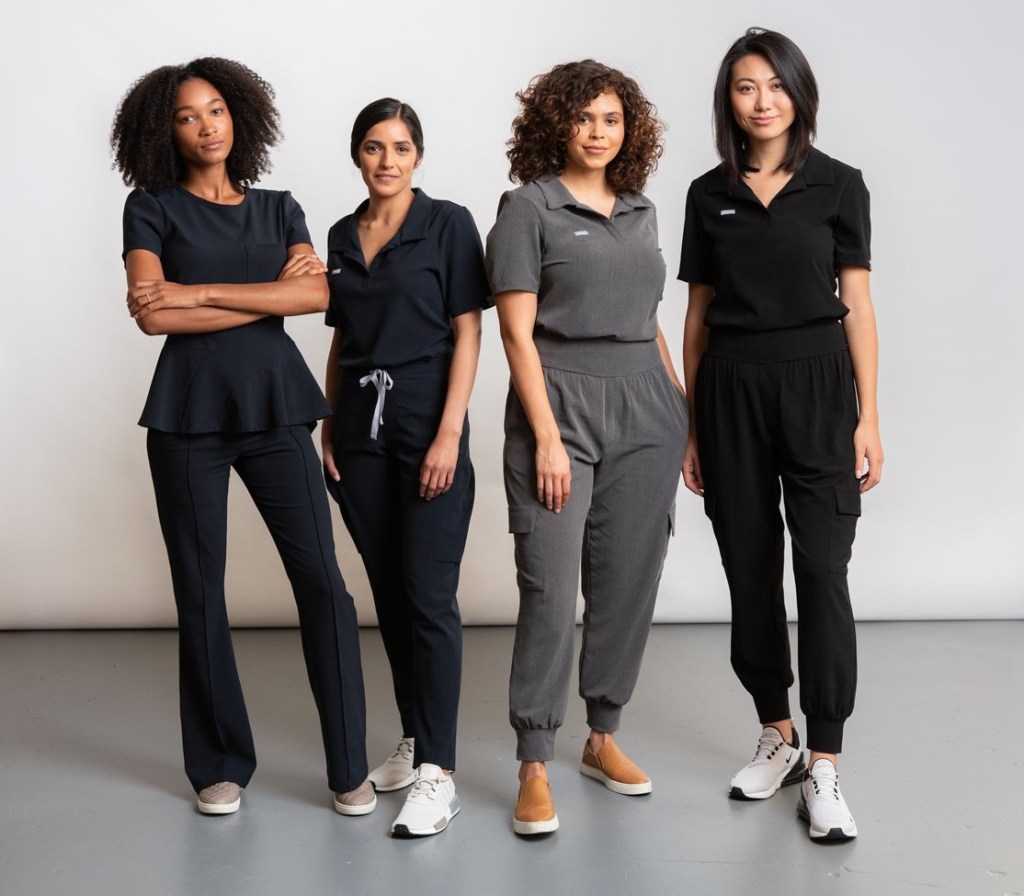
If you’re considering buying scrubs and want an alternative to the ones offered by the manufacturer who posted the inflammatory ad, consider Sway Scrubs. Sway Scrubs (swayscrubs.com) launched this year and is a female, Black-owned business. I have no affiliation with Sway Scrubs but have been considering purchasing their scrubs to support more minority-owned businesses. Plus, they have cute designs, so I’m eager to try them once I decide to buy more scrubs!
Image from swayscrubs.com
Since graduating from nursing school and looking for jobs, I’ve held off on buying more scrubs if my future place of employment has specific uniform requirements. I own two pairs of Code Happy scrubs outfits because that is what my nursing program offered. I’ve worn and would recommend Code Happy scrubs. I would purchase them again because they fit my short, stout body well, and the price was reasonable. I’m so vertically-challenged that when I order petite-sized pants, I usually have to alter them. I was honestly shocked that I didn’t have to hem the Code Happy petite pants – the drawstring waist and ankles make all the difference!
Below is a pic of me in my Code Happy scrubs during Nurse’s Week this past Spring. The hospital was celebrating healthcare workers as heroes – hence, the Wonder Woman statue in the back. Women in healthcare are heroes – many are pioneers or have had to endure extra criticism just because of their gender. Women in healthcare should be celebrated and respected. We need to encourage diversity in healthcare and recognize the importance of each team member in caring for patients or clients. Titles of DO, MD, RN, LPN, CNA, RT, Housekeeping, etc. should not change how others treat you. Titles may indicate the scope of practice and education, but it shouldn’t dictate how or if others treat you with dignity and respect. Also, an inclusive culture welcomes and encourages all genders into both medicine and nursing.
Here is a snapshot of me in Code Happy scrubs during an Advanced Med-Surge clinical. I liked how the Code Happy scrubs fit my hard-to-fit body, but I also liked all the storage. As you can see, I took advantage of all the pockets my scrubs offered!
Unfortunately, a favored scrubs manufacturer created an ad that belittled female healthcare workers and DOs. Thankfully, the company has since removed the ad, and hopefully, an educational moment occurred for the company and others. We all have biases, but our actions and lack of awareness may promote others’ disadvantage. We can evaluate how such prejudice affects others through the language and images we use and the businesses we support. Are we empowering others or tearing them down? Are we causing division or uniting others in healthcare? Are we supporting companies that align with our values? As I’ve yet to purchase scrubs beyond nursing school, I would love to hear your recommendations for scrubs or your experience with other scrub manufacturers!
….
Update: As soon as I posted this, I noticed @nurselifern pointed out the same company created a similar ad poking fun at male RNs. A male RN in one of their ads was also reading a “…Dummies” book upside down! I’m really shocked this wasn’t uncovered or discussed sooner. We need to support diversity and inclusion in healthcare! I’m amazed that a company that caters to healthcare professionals and relies on their support could spend time, money, and resources to insult and belittle them in their marketing campaigns!
Last month, I convinced a former nursing school classmate to join me in giving blood. She had never donated before, so I was so excited for her, but I was also happy someone was willing to join me! Is it sad that the only time I feel I can be “social” during the pandemic is when I’m doing things like going to school or donating blood? If you’re like my friend and have never given blood or wonder what blood donations are like during a pandemic, this post is for you!
Donors receive gift cards and discounts.
Aside from supporting someone else’s life, donors got perks such as gift certificates and discounts to restaurants or retailers like Amazon. Depending on the blood drive, donors can be entered into prize drawings or receive items like water bottles. Donors typically get water, juice, and snacks after their donation, too. Recently, the American Red Cross announced they would test blood donations for COVID antibodies – this free antibody test is a significant new perk in donating blood!
Blood donors get free COVID-19 antibody testing.
My friend and I were both eager to get the COVID antibody test for free. We knew of healthcare workers and personally worked with a nurse who showed no COVID symptoms but tested positive for antibodies. “Antibody testing may indicate if the donor’s immune system has produced antibodies to this coronavirus, regardless of whether an individual experienced COVID-19 symptoms. A positive antibody test result does not confirm infection or immunity” (redcross.org). Regardless, we wondered if we would have positive antibody results and secretly hoped we were one of those asymptomatic people with possibly protective COVID antibodies.
Make a donation appointment early – appointments fill up quickly.
Before the pandemic, many blood drives accepted walk-in donors without appointments. Now, anyone donating must make an appointment ahead of time. Many drives fill up for several weeks or even a month in advance.
There are many blood drives – make an appointment for a location/date/time convenient for you.
We found a blood drive and made a donation appointment at a beachside hotel in Marina Del Rey, here in Southern California. I decided to pick this hotel in particular, because I liked their restaurant and knew they had a scenic outdoor dining patio. I figured I could brunch with my classmate as a mini celebration to her inaugural blood donation but also to us graduating from nursing school. We had not celebrated our graduation together in-person due to the pandemic. We had spent enough time together at clinicals and lunch breaks in hospitals during the pandemic, however, that we thought an outdoor post-graduation brunch would pose minimal risk.
The blood drive was at a hotel right on the marina. It was in a ballroom with windows overlooking the beach, in an area separate from their dining patio.
Save time and use RapidPass for pre-donation reading and screening.
To save time completing questionnaires and screening questions before the actual donation, donors can answer health history questions and complete the pre-donation reading using their computer or mobile phone the day of the donation via the RapidPass application. Travel, medications, and certain kinds of activities may make people ineligible to donate blood. Doing the pre-donation reading via RapidPass may help a person discover whether they should donate blood before showing up to a blood drive.
I used RapidPass (https://www.redcrossblood.org/donate-blood/manage-my-donations/rapidpass.html) to minimize the amount of time I had to sit and wait in a room filled with strangers. While appointments ensure spacing between donors and minimal crowding, I still felt uncomfortable at the prospect of spending an hour in an indoor, enclosed room with random people. (I don’t know why, but I never had this concern during clinicals at hospitals. Maybe it’s because I had to be at my clinicals, but blood donations are entirely voluntary). Upon arrival, I showed the registration volunteers my photo ID and RapidPass confirmation barcode. After that, it was a quick process for the temperature and hemoglobin screening before my actual blood donation.
Wear a mask. If you are sick, visit a doctor or stay home.
The American Red Cross requires blood donors to wear a face cover or mask and keep their mask on upon their arrival and during their appointment. They also screen donors to ensure they are not running a fever or exhibit other symptoms. My temperature was taken twice by two different people before I gave blood. The registration volunteers asked me to use hand sanitizer, and everyone wore masks and displayed proper hand hygiene. I appreciated all the precautions during my appointment.
Although donors get free COVID antibody screening, if people are sick or have COVID symptoms, they should get screened for COVID and diagnosed elsewhere. “The Red Cross is not testing donors to diagnose illness, referred to as a diagnostic test” (redcross.org). If I had an active infection, I wouldn’t want to risk exposing blood drive volunteers, staff, and other donors to my illness, even if I thought it was only a cold. I would hope others would do the same and quarantine themselves according to CDC recommendations if they were sick.
Hemoglobin levels will be tested and must be normal.
Before every donation, the American Red Cross gathers a drop of blood by pricking a potential donor’s finger and tests that sample for hemoglobin levels. The process is very similar to the point of care glucose testing I did during clinicals. I tried giving blood in August but could not since my hemoglobin levels were too low, which was likely caused by low iron.
Because the American Red Cross no longer accepts walk-in appointments, anytime a potential donor is turned away from giving blood that same day, the Red Cross cannot quickly fill that newly-vacant appointment. The pandemic has severely impacted the usual avenues of blood drives at schools, offices, or churches since these groups have not been meeting in-person or on-campus. To ensure I could donate and not waste a donor spot, I decided to take some iron supplements a week before my September donation appointment. Luckily, it raised my iron levels high enough that I was able to donate blood. I only needed one finger prick to show my hemoglobin was within normal limits! There have been times when I required a second sample to qualify as having normal hemoglobin levels. Or, like in August, the second sample confirmed that I was below normal limits. (For additional information about iron levels and blood donations, check out: https://www.redcrossblood.org/donate-blood/blood-donation-process/before-during-after/iron-blood-donation/iron-informationforallblooddonors.html)
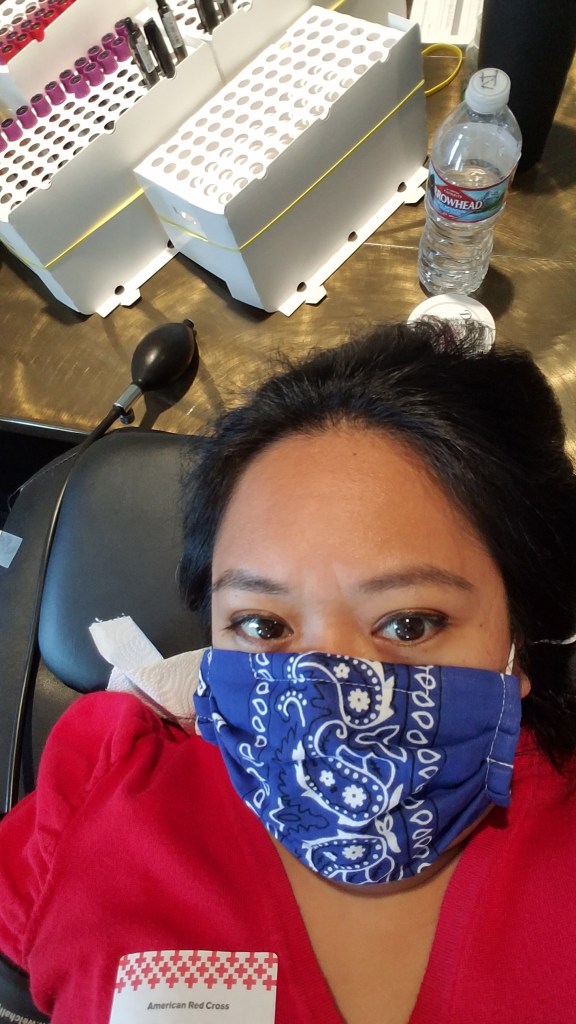
Masked and lying down while donating blood.
After all the screening questions and tests were complete in a makeshift cubicle area, the staff person led me to the room’s blood donation section. While you donate blood, you lie on a cushioned table that is as comfortable as the doctors’ offices’ exam tables. I was fascinated by the venipuncture and blood donation process and asked the person who collected my blood if she had any tips. Unlike some of my personal experiences during nursing school, she was confident in poking me and didn’t struggle to find a vein. Poking people all day for the past ten years made her skilled at venipuncture – I hope to be just as confident and proficient someday! (Tip: go for a vein you can feel, not one you can only see)
Full transparency: the collection needle is big.
I will not lie – seeing the needle they used to collect my blood was a little intimidating. I had never been afraid of giving blood before, but it had been a while. I had never seen or used a needle that huge (16-17 gauge) on a person or mannequin in all of my nursing school! The needle they used reminded me of a draw needle (used to draw up medication from a vial, typically more massive than any injection needle I ever used on any patient). Because a pint of blood is needed instead of merely test tube quantities, the collection needle needs to be big enough to allow for decent blood flow. Otherwise, the donation process would take much longer.
Once the needle is in, it typically takes no more than 10-15 minutes to donate blood. Some old co-workers I know would try to race each other and see who could fill up the bag and donate the fastest. I think their donation took only 3-5 minutes on one occasion. However, I was in no rush and was honestly just happy to be out of my house and around people.
What my arm looked like later that evening, after removing the bandage. I got a minor bruise at the puncture site. This small bruise didn’t hurt and disappeared after a couple of days.
After the actual donation, prepare to rest for 10-15 minutes before leaving
After my donation was complete and they bandaged me up, they invited me to sit and relax in the snack area . There is usually a table of juice and snacks like granola bars, trail mix, or crackers and cookies at every blood drive. Donors are encouraged to sit and rest and snack on something after their donation, before they leave. This also allows the staff to observe donors for any reactions to the donation.
I had a friend who wanted to skip sitting and resting after her donation and ended up fainting as she walked out the door. If you feel light-headed after donating blood, sit down and let someone know! Blood loss and dehydration can cause people to experience orthostatic hypotension or dizziness upon standing or changing positions.
It’s essential to hydrate just as much after a donation as much as it is before donating blood. The hotel restaurant was having a happy hour in their outdoor patio that afternoon. As tempting as it was (I haven’t been to a happy hour since before the pandemic), alcohol is not recommended after donating blood. I stayed hydrated!
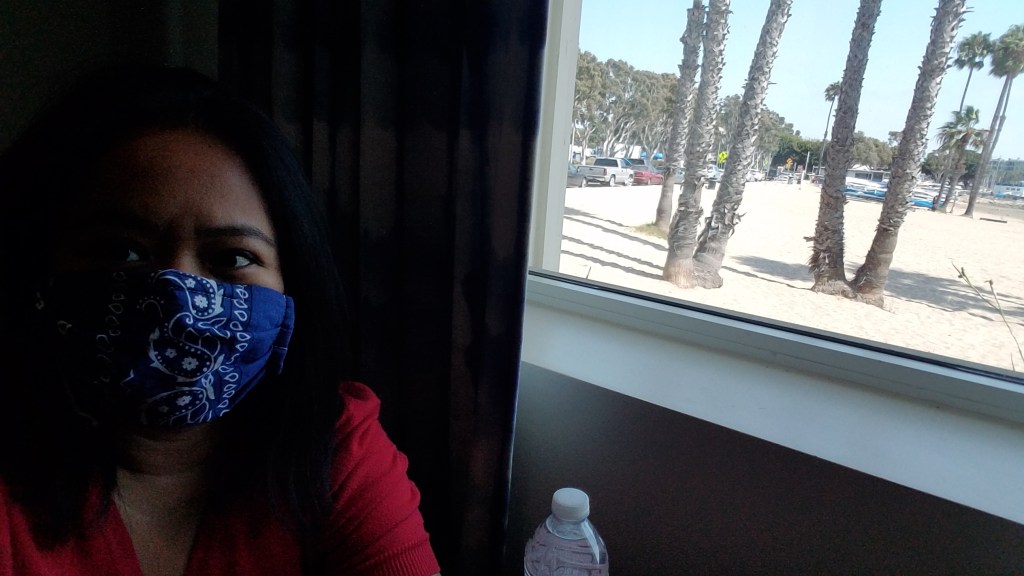
Snack selection and view after my blood donation. In addition to my snacks, I got to appreciate a clear sunny day, palm trees, and a beach view for my blood donation
You may need to modify activities after your donation.
Like alcohol, strenuous exercise is not recommended the same day after donating blood. If you think you need a high-intensity workout the day of your donation, do it before giving blood. Years ago, when I had daily running routines and ran marathons, I would schedule my workouts before donating blood or use a donation day as a rest day. Give your body at least the evening to recover from donating before resuming working out heavily. [Un?-] fortunately, regularly working out hard-core is not something I’ve been doing recently, so I didn’t have to reschedule anything.
I’m not eligible to donate whole blood again until next month; I plan to donate once 56 days have passed since my last donation. My friend wants to do it again, too. Donating blood helps replenish an impacted blood supply. It is an easy, smooth process, I get to ask highly experienced professionals about venipuncture tips to support my nursing practice, and I get to invite friends to join me! Plus, my friend and I like the idea of regularly getting a free COVID-19 antibody test!
I’ve been suffering from breakouts on my face. Even as an adult with aging skin, I periodically battle acne, but feel like it’s been especially pronounced recently. In some ways, my reusable cloth mask is a nice way to hide my recent acne breakout, but I realize it might also contribute to it. Recently, the term #maskne has been used to describe acne appearing around or underneath masks. However, I am a mask-wearing advocate and believe a mask should be worn during this pandemic when in public or around others outside my household. Outside of staying home more and un-masking, here are some things I’ve done to address my #maskne:
1. Wash my reusable masks or change them more frequently
Reusable masks should be washed after every use. My usual routine at the start of this pandemic would be to handwash my only reusable mask with a laundry bar soap as soon as I was home for the day. Four to five months into the pandemic, I started to get lazy and would re-use an unwashed mask if I only wore it briefly the day before. I recognize this is poor hygiene and have resumed ensuring my face covering is washed before wearing it, even if I wore it for only 30 minutes the day before. Also, now that I have more face coverings, I throw them in the hamper to eventually be machine-washed with my weekly load of laundry.
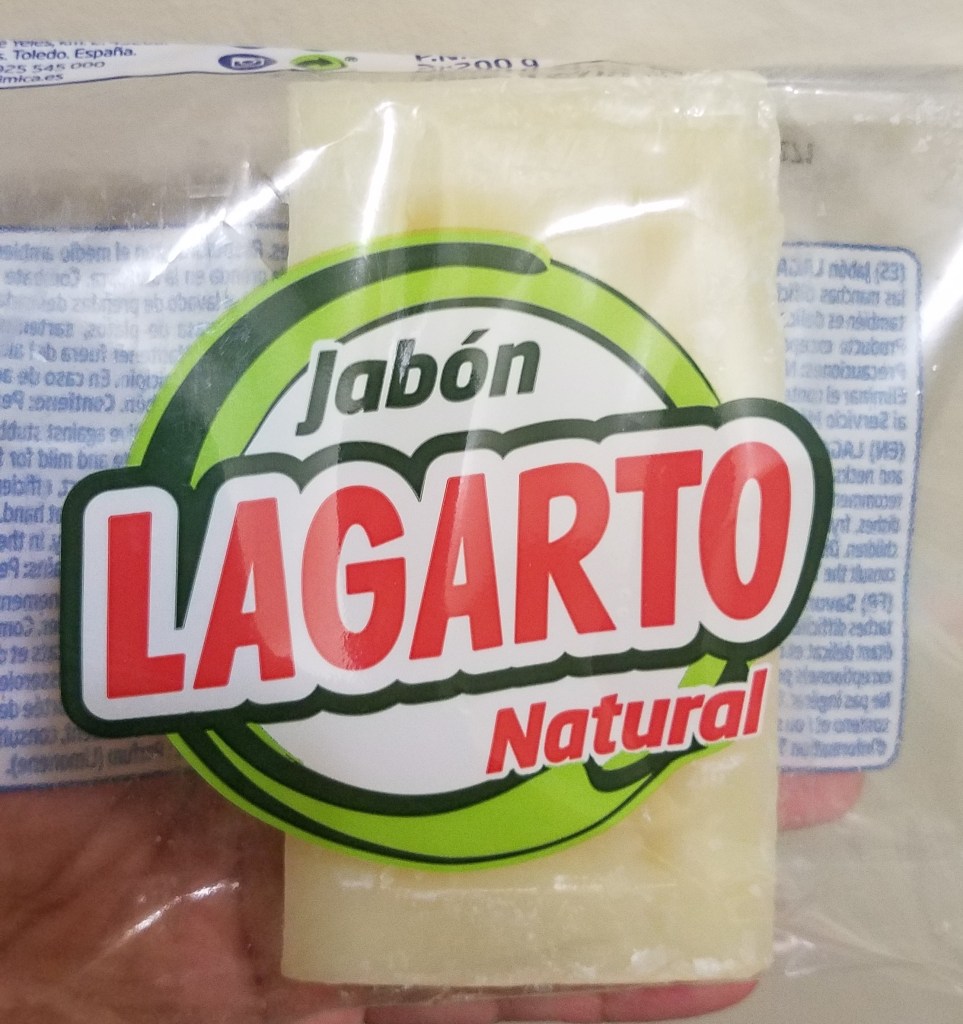
Lagarto is the name of the bar soap I use to for hand-washing my mask. I bought this on a trip to Spain to do laundry while traveling. It worked well and came in a 3-pack, so I took it home with me and still use it for hand-washing clothes!
Another thing is it’s been a lot warmer since the pandemic started. We have had heat-waves where I’ve been continuously sweating, and my cloth face covering would absorb my sweat. I’ve had to replace my face covering multiple times daily to ensure it was clean; I didn’t want to have a dirty piece of fabric resting on my face all day. When a reusable face mask is soiled, stop using it and wash it!
2. Change my toothpaste
Before masks ever became a standard fashion accessory, I would periodically suffer from adult acne. I would breakout, particularly around my mouth. I read a blurb in a magazine stating that ingredients in one’s toothpaste can cause breakouts and skin irritation. After reading that article, I switched up my toothpaste and noticed a considerable improvement in my skin. I would rarely break out around my mouth.
To celebrate my recent graduation, I went on a road trip vacation with my family. Unfortunately, I did not pack my usual toothpaste. Complacency got the best of me, and I didn’t think it would matter for a 3-day getaway. I got a zit by my upper lip and then a pimple on my lower lip shortly after our trip. I’ve since switched back to my usual toothpaste.
I also started washing half my masks by hand to see if it makes a difference compared to my machine-washed masks. Just as personal care ingredients can cause skin irritations, detergents’ ingredients can irritate the skin, too. It’s for this reason that there are non-allergen and fragrance-free detergents. If your skin is breaking out by your cloth mask and you clean the mask regularly, try washing with a different detergent.
3. Use acne patches or dots
When I was a teenager, acne dots or patches did not exist. The popular anti-acne products back then were Sea Breeze, Clearasil, Clean & Clear, and Neutrogena. I only discovered acne dots or patches recently and started using them about a year ago. Some patches contain medication (like salicylic acid, a typical anti-acne ingredient), and some are merely hydrocolloid patches. In nursing school, I learned hydrocolloids are used to treat some wounds. My acne can sometimes be painful and feel like a wound! I never had the opportunity to perform wound care on a patient using hydrocolloids, so I think it’s neat that I get a sense of what hydrocolloids are like when I use these patches on myself.
Somehow, I have started to accumulate acne dots and patches. Some I forgot I purchased while others I bought while traveling. I think they work, but they are all a little different, and they each have their merits.
I love these patches or dots because they protect the pimple or zit from further irritation. If I have a pimple and wear an acne dot, I don’t have to worry about fabric or skin rubbing up against it and further aggravating my pimple. It’s pretty much an adhesive disk applied to the skin. One drawback of using these is it’s been challenging to get them to stay on my skin when I’ve been sweating.
4. Relax
I get acne due to hormones – stress or menstrual. During nursing school, I drank mostly caffeinated beverages, ate quick-to-eat not-so-nutritious food, and periodically got less than 6 hours of sleep. Poor diet, lack of sleep, and project and exam stress would undoubtedly affect my skin and cause me to break out.
I never drank so much coffee until I started nursing school. Now that I’ve graduated, I try not to drink coffee daily. The pandemic and not wanting to go out frequently have also forced me to better plan my meals. Since I’ve graduated, I get more sleep and have been trying to relax more by catching up on tv shows and doing things I enjoy while I quarantine at home. However, I continue to feel a little anxious because I still need to take the NCLEX and find a job amidst this pandemic.
I don’t think that I will ever eliminate stress or anxiety, but I don’t want to either. I believe stress can sometimes be a good thing, giving the motivation to move forward, improve oneself, or providing an impetus for change. On the other hand, too much stress or high stress for too long can lead to health problems; I recognize this and try to lead a more balanced life.
Even with efforts in reducing stress, I still periodically get acne due to hormones associated with my menstrual cycle. There’s not much I can do about it, according to my doctors. This week, I tried washing with Panoxyl (thanks to recommendations by YouTube bloggers Cassandra Bankson and Dr. Dray) and targeting specific areas prone to breakouts. I have yet to determine if this acne wash truly helps since I just started using it, but it feels good that I’m at least trying to care for myself and try something new.
Since many variables can lead to “maskne”, it’s hard to say that there is one sole cause or solution. So far, doing all of the above has improved my skin. One pimple has disappeared altogether while the other is shrinking and less painful. I’m not the only one suffering from #maskne; I want others to realize their mask may not necessarily cause their breakouts. Instead of reducing mask-wearing, try switching masks or washing masks more frequently. Change toothpaste, soap, or detergents. Treat breakouts when they occur, and practice self-care by reducing stress and anxiety. I encourage others to follow public health recommendations and WEAR A MASK around others. We are still in a pandemic – with acne or without, I’m wearing my mask!
If you’re pursuing Nursing, you may have heard of the TEAS because some Nursing programs require applicants to take it and submit their score as part of their application. TEAS, or the Test of Essential and Academic Skills, is a standardized, nation-wide exam administered by Assessment Technologies Institute (ATI). Like many nursing programs, my BSN program uses the TEAS as a screening tool for their candidates. The minimum TEAS percentile my program considered was 80. However, some of my cohort classmates shared that they scored 95-99 percentile overall on their TEAS, well above the minimum for my school. If you want to apply to a competitive program and be an attractive applicant, you must do well on the TEAS. For this post, I’m sharing my tips for how I scored in the 99th percentile when I took the TEAS in Fall 2018.
My Biggest, Most Important Tip: Know Your School’s Requirements!
My most important tip is to know your school’s requirements. If a school in which you’re interested in applying is offering a Nursing forum or information session, attend the session to understand the admissions requirements and clarify questions you might have. Some schools do not require the TEAS for admission. Other schools do not require the TEAS until you submit an application and they give you an invitation to take the TEAS. Some schools require the TEAS but will only allow students to take it once in a six month period. Some programs will not take your best TEAS score in their application timeframe; they will take the first score in the allowed timeframe. Understand your prospective school’s admission policies.
One other perk I discovered while attending Nursing School Information sessions before taking the TEAS is one school offered a discount code for ATI TEAS study packages. However, the biggest reason to attend an information session (or speak to an admissions officer) is to clarify admissions requirements and any stipulations the school or program may have regarding the TEAS exam. This is particularly important if you’re applying to multiple schools since each have their own admissions policies.
Tip: Complete your Pre-Requisites
When I took the TEAS, I had completed all my Nursing School pre-requisites (except for Philosophy and Religion). My Anatomy & Physiology and Chemistry prerequisites definitely prepared me for the exam. Completing my pre-requisites was particularly helpful because the TEAS emphasizes Science. (The TEAS covers Science, Reading, Math, and English and Language Usage. For more information, visit https://www.atitesting.com/teas/register/). I had taken the pre-requisites within the year so a lot of the material was recent for me, and I was grateful that the exam material was a review of what I already learned.
If you’re not done with your pre-requisites, do not get discouraged – other students online said they took the test and did fine without completing their pre-requisites. However, they spent a lot of time teaching themselves and learning the material for the first time.
Tip: Use a study guide practice exam to focus your efforts
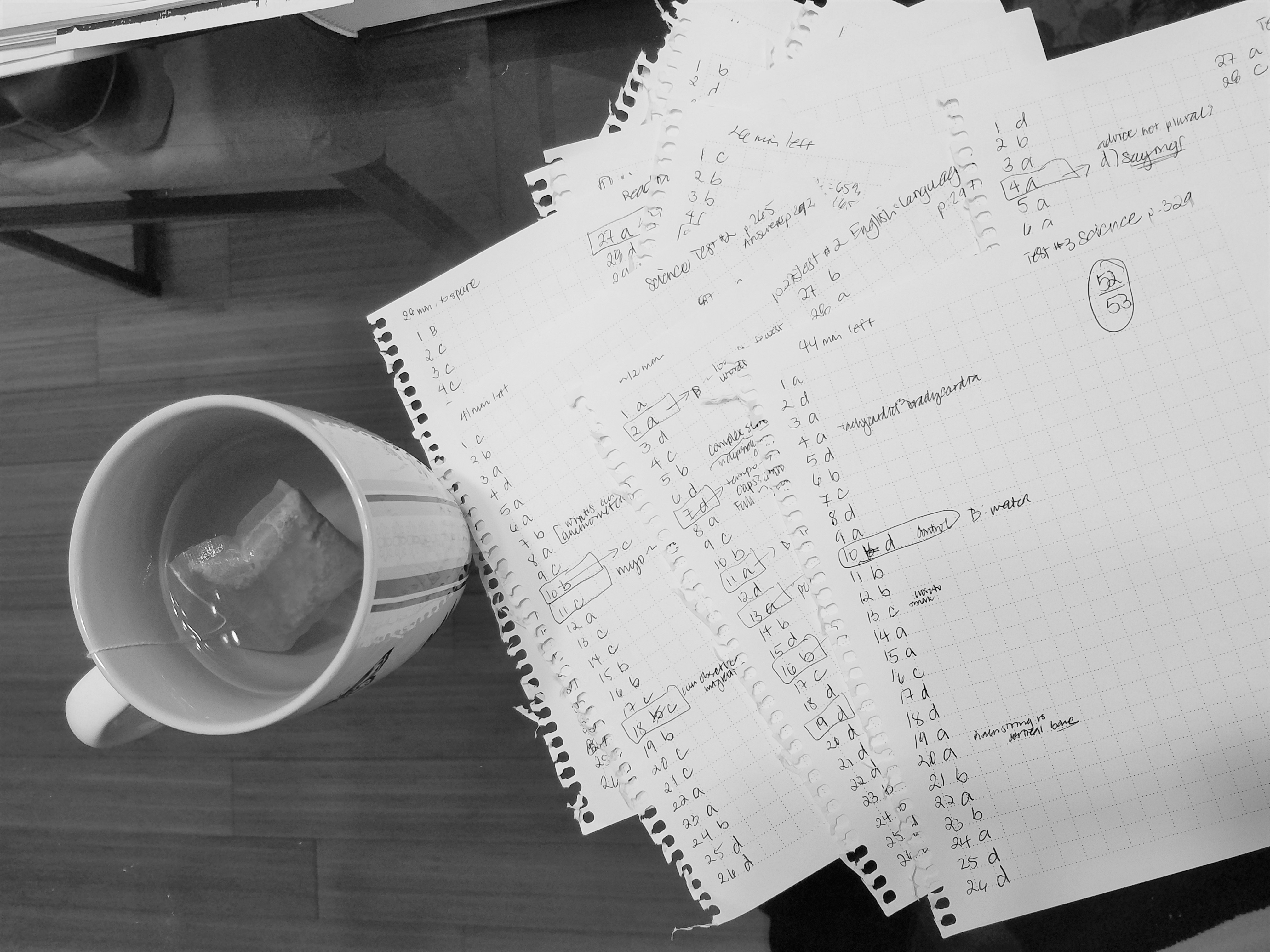
I invested in the yellow Mometrix study guide since it was so highly recommended by people online. My time was limited, and I had no intention of reviewing and reading the entire study guide. Instead of studying each chapter, I took a practice exam in the book to identify my weak areas so I could focus on them. I only reviewed the topics or areas where I scored low from the practice exam. After I felt I studied sufficiently, I would take another practice exam. I would continue to use my lowest scores (and wrong answers) to guide me on what I should study. After studying some more, I would take a different practice exam. I would continue this process until there were no more exams in the study guide to take.
My answer sheets for all my practice exams. I would time myself and give myself the same amount of time as the TEAS for each section. I would then review my incorrect answers and study those topics a little more.
Tip: Use your library to access study guides for FREE
I eventually ran out of practice exams in one book, so I used multiple study guides to prepare for the TEAS. My library had TEAS study guides available both online as ebooks and hardcopies. Take advantage of your public library since it is typically a FREE resource! Research availability and reserve your TEAS study guides early because these books can be in high demand! There was a waitlist, but I was able to place some study guides on hold and have them sent to my local branch weeks before my TEAS exam, which gave me plenty of time to prepare.
Tip: Use study tools according to your style of learning
Take advantage of any or all the tools that will help you learn or retain the material you need for TEAS! I know I’m a visual and kinesthetic learner. Flash cards are often an effective way for me to study. I do well when I write/design my own flash cards and study from them. I kept my flashcards from Anatomy & Physiology and used some of them again when studying for TEAS. Another study tool that I thought was helpful was “The Anatomy Coloring Book”. I actually used this during Anatomy & Physiology pre-requisites. It helped me learn and understand various systems of the body. I think it’s a great resource to have regardless of the TEAS, and I even referred to it recently while in Nursing school to review the kidneys and urinary system for Pathophysiology.
Other learning tools I found useful were YouTube videos from Khan Academy and Armando Hasudungan (a doctor who is also an incredible artist). Many students today use YouTube to supplement their learning, so take time to explore which channels best complement your learning style. Another popular tool is Quizlet, where you can create and share electronic flashcards and quizzes for yourself, but also where you can view other people’s flashcards and study guides. (WARNING: Be cautious when using shared content or YouTube – sometimes material other students post is not the most accurate).
Now that I’m in Nursing school, I watch the YouTube channels for NRSNG and RegisteredNurseRN. While these are resources geared for Nursing students, take advantage of their Anatomy & Physiology reviews in preparation for the TEAS. If you are an auditory learner, you could also listen to NRSNG Radio.
Since starting Nursing school, I have also discovered Picmonic – a great tool for visual learners and for folks who can use stories and pictures to remember concepts. It would have been nice if I knew about them earlier because they have lessons for Anatomy and Physiology! You can try Picmonic for free with one lesson per day. If you want to view more lessons, a subscription fee is required.
There are many tools beyond study guide books to help you prepare for the TEAS – take advantage of them and use the ones that suit you best!
Tip: Invest in practice exams from ATI
While the study guide practice exams were certainly helpful, I found the ATI practice exams to be a little more detailed than what was in the Mometrix or McGraw Hill study books – which helped me on my actual TEAS exam. The practice exams also summarize the areas needed for review and provides a study plan. The review topics correlate directly to chapters in the ATI Study Manual (which I did not have), but still gave me enough information for me to focus my review using the materials available to me.
The online ATI practice exams are structured the exact same way the computerized TEAS exam is structured – with flags, countdown timer, and calculator embedded into the exam. Like the online exam, you can flag questions you would like to review in your practice exams before submission. The actual TEAS test and practice exams allow you to easily revisit flagged items at the end of a section so you don’t have to toggle back and forth through all the other questions. I’m the kind of person who always double-checks my exam and doubtful answers prior to final submission, so I found the flagging feature helpful. I also liked that the practice exams were modeled after the actual computerized TEAS exam, so I had an idea of what to expect on exam day.
Tip: Find out if your TEAS exam will be computerized or not.
The TEAS was offered at one of the universities to which I was applying via computer. For my TEAS, I was in a computer lab with a proctor, and each student had a computer. What’s nice about the computer version is the sections can all be taken at your own pace, within the allowable timeframe. Currently, students get 64 minutes to complete the Reading section, 54 minutes for Math, 63 minutes for Science, and 28 minutes for English and Language Usage. Each student gets the same amount of time to complete each section. However, if you finish a section early, you don’t have to wait for the time limit to end before moving onto the next section. The times are all tracked on your computer so you can’t exceed the alottment, but you can easily move on once you’re done with a section.
Some people I know hate taking tests via computer, so they purposefully signed up for a test center offering the paper version of the TEAS. (However, if you plan to continue with Nursing, I believe the NCLEX is on computer, so you might as well get used to computerized tests)! It’s always good to minimize surprises on test day, so find out if your exam is offered on paper or computer to set expectations. Plus, if you take a paper exam, you’ll need to find out what kind, if any, calculator you’re allowed to bring!
Tip: Follow ATI on Facebook
ATI offers live video tutoring sessions for the TEAS. They also offer TEAS workshops via Facebook. If you can’t join live, you can view recordings. This is another FREE tool I recommend you use to prepare for the TEAS.
Tip: Do NOT take the TEAS as practice
I discourage students from taking the TEAS for practice. For some Nursing programs, you are unable to retake the TEAS until six months after your prior TEAS. Some students think they will take the TEAS for practice and simply retake it if they do not do well. They may come to find this is not possible for the program to which they are applying. Use the study guides and ATI practice exams for practice – not the TEAS! Your goal is to do well when you take the TEAS the first time. Save yourself the agony from having to study again and save money on your test registration fees! It is possible to take the TEAS once and do well. I did, so I believe it’s possible for anyone.
Personally, I relied on doing well on my TEAS (and pre-requisites) because my undergraduate GPA was low. It was so low, it fell below some school’s admissions requirements. I got a 4.0 GPA on my pre-requisites, but I knew I also needed to do well on my TEAS to get into my accelerated BSN. I guess it worked, because I got into my top choice nursing school! If I did it, you can too!
Hopefully, my tips and experiences are helpful and encouraging. I didn’t number them because I don’t think any one is necessarily more important than the others (except for knowing your nursing school’s requirements – definitely do this first)! If you have found something useful in this post or on my site, please share it with others! If you’ve taken the TEAS and have other TEAS tips to share, I welcome them! Please also let me know if there are other topics you’d like for me to discuss. Thanks for reading!
This list makes me giddy…and is a sign that I’ve completed my background check & clearance for school!
I’m a checklist person, and this list is so satisfying! Anyone else use checklists and feel happy when all tasks are completed? Completed checklists instill a feeling of accomplishment and productivity for me. I love the visual cues and color-coding, too! No “Incomplete” reds or “In Review” yellows here! I mean, just look at all that “Complete” GREEN!
My to-do list for my background check and clearance for my nursing program is finally complete! Some of the things I had to do or submit before school started were a criminal background check, drug screening, immunizations and titers (immunization records were not enough), CPR/Basic Life Support Certification, Hospital Fire & Life Safety certification, physician’s physical examination and respirator clearance, and HIPAA Certification. I had many items on my list already done since I volunteer at a local hospital, but there were many school-requirements not needed by my volunteer program or that were about to expire. Even if I had the task or item complete, it took time to scan and upload all the documentation and more time for the background-check company to review and “approve” the submission.
TIP: Gather and electronically scan all your immunization records because immunization requirements (or waivers) are standard for working in a hospital setting. Have your certifications available too. An instructor advised me that I would need to provide these items regularly since each hospital/clinical site has their own clearance process and some things must be done annually or periodically as a healthcare worker. Having these records readily available and organized saves time and allows self-tracking of upcoming expiration dates.
If you already collect and organize your documentation, I’d love to hear what organization system you use! How do you keep track of tasks you need to accomplish? Share your tips in the comments below!
Taken by #thematurestudentnurse from the trails surrounding Baldwin Hills Scenic Overlook (Culver City, CA)
I enjoyed spending time with a friend hiking some local hills this morning. It was perfect weather and we got to enjoy some pretty wildflowers and scenic views. I so appreciate carefree timelessness with friends. I don’t often have a lot of free time being a wife, mom, volunteer, and student pursuing a second career. However, I recognize how restorative it is for me to spend time connecting with others and exploring my neighborhood.
What nourishes or comforts you? It’s important to understand what brings you joy or soothes you. Identify what that is and make a list you can reference periodically. In times of stress, you can choose healthy coping mechanisms from that list or at least be aware of what you can do to nourish and restore yourself. In “The Gifts of Imperfection”, Brene Brown refers to having this list as comfort wisdom. Brene Brown asks her readers to distinguish between what we use to numb ourselves versus what comforts and refuels us. It helps to have this self-awareness, particularly because it’s easy to confuse numbing or escape for comfort.
I developed my “comfort wisdom” list years ago after taking an online Oprah course with Brene Brown, compliments of my employer’s women’s resource group. The list of what comforts me still applies today. At the top of my list is “intimate sharing and time with loved ones”. Also included is “travel & exploration” and “hikes, walks, and exercise” among other activities. I am grateful I was able to incorporate multiple items from my comfort wisdom today, particularly before I begin an intensive nursing program. I’ve discovered I have more joy and peace in my life when I use my comfort wisdom.
Identify and develop your own comfort wisdom. Once you make that list, regularly incorporate items or activities from that list into your life. You may find you have to schedule time for it. My friend and I planned this hike over a month ago and even had to reschedule a couple times due to illness and then out-of-town guests visiting, but we were committed to spending time with one another. Everyone has their own comfort wisdom; something that refuels me may not refuel you. As an extrovert, I love hanging out with groups of friends and meeting new people. In contrast, my introverted husband would be exhausted doing the same thing. Honor yourself by using your comfort wisdom and refueling periodically – I know it’s a practice I’ll need to do for myself in nursing school and in my future career!













 The Mature Student Nurse