I know it’s been a while since I’ve posted. I feel like I’ve been struggling lately and don’t know what words of inspiration to provide. I find myself working when I didn’t plan to work to please my boss. I recognize that consistently not holding the boundaries I set for myself is unhealthy and causes suffering and resentment. Establishing and maintaining boundaries is a skill I have yet to master. I don’t know if I’d even call myself competent.
Sometimes I find myself working extra shifts, not because I want or need to, but because I want to keep my boss happy. I want her to give me a good recommendation when I put her down as a job reference. (I work as a COVID tester but am looking for an acute care RN role). However, when I work extra days to please my boss, it costs me a chance to recharge myself, spend time with family, job search, or blog. For example, even though I said I was unavailable to work the day after my second-dose COVID vaccination, I found myself working when I didn’t plan on it because my boss was short-staffed and begged me to work. My arm was sore, and I was tired and achy, but I had no other symptoms, so I obliged her plea for me to work. I had hoped to be taking it easy at home the day after my vaccination to fill out my daughter’s complicated kindergarten applications and other job applications for myself. Instead, I wore myself out by working the day after my second shot. By the time I got home, I felt so fatigued that all I could do was shower and lie in bed all evening. I couldn’t even pick up my daughter from her preschool; my husband did. My boss asked me to work again the following day (a day I usually have off), and I said I could not; I felt like I was fighting the flu! I found myself to the point of exhaustion before I finally said “No,” to my boss.
Being short-staffed seems to be a common theme no matter where a nurse works. (There are so many memes about this!) I am not a bad employee if I tell my boss I am not working extra days. Saying “No” is a skill I know I must strengthen to maintain the boundaries I set to keep myself healthy and balanced. [Un]Fortunately, it looks like I will have plenty of opportunities to practice saying, “No.”
Before I became a nurse, I was the type to cram a lot into my schedule. I still am this way. Usually, I enjoy it, but sometimes it’s stressful, especially when running late from event to event. However, since marrying my husband and having my daughter, I’ve been conscious of my family’s schedule and try not to burden them with too much activity. A nurse- and mom-friend told me her life coach suggested she schedule no more than three things in a day. I’ve been good with this for my family, but I am trying to uphold this goal for myself. I accomplish goals I set for myself more efficiently, and I am more satisfied and less overwhelmed when I create a manageable schedule.
I still have many goals and lots of things I feel I need to do or accomplish each day. Fortunately, I realize 1) I do not need to do everything all at once, and 2) Some things (like working or blogging) may fall off my schedule to focus on completing other things (like job and kindergarten applications). Honestly, I should make one of my goals to stop being such a people-pleaser, and I would be able to say NO guilt-free and struggle less. I am working on this, so thanks for your patience during my mini-break from blogging the past week!
Due to an unexpected quarantine from my daughter’s exposure to a COVID positive person, I found myself stuck at home for two weeks in January with my husband and daughter. Thankfully, all of us remained asymptomatic and tested negative for COVID. However, I adhered to the health recommendations to quarantine, and I did not work or leave the house outside of medical appointments for 14 days. Homebound, I decided to make my 2021 vision board a fun, creative activity I could do with my daughter.
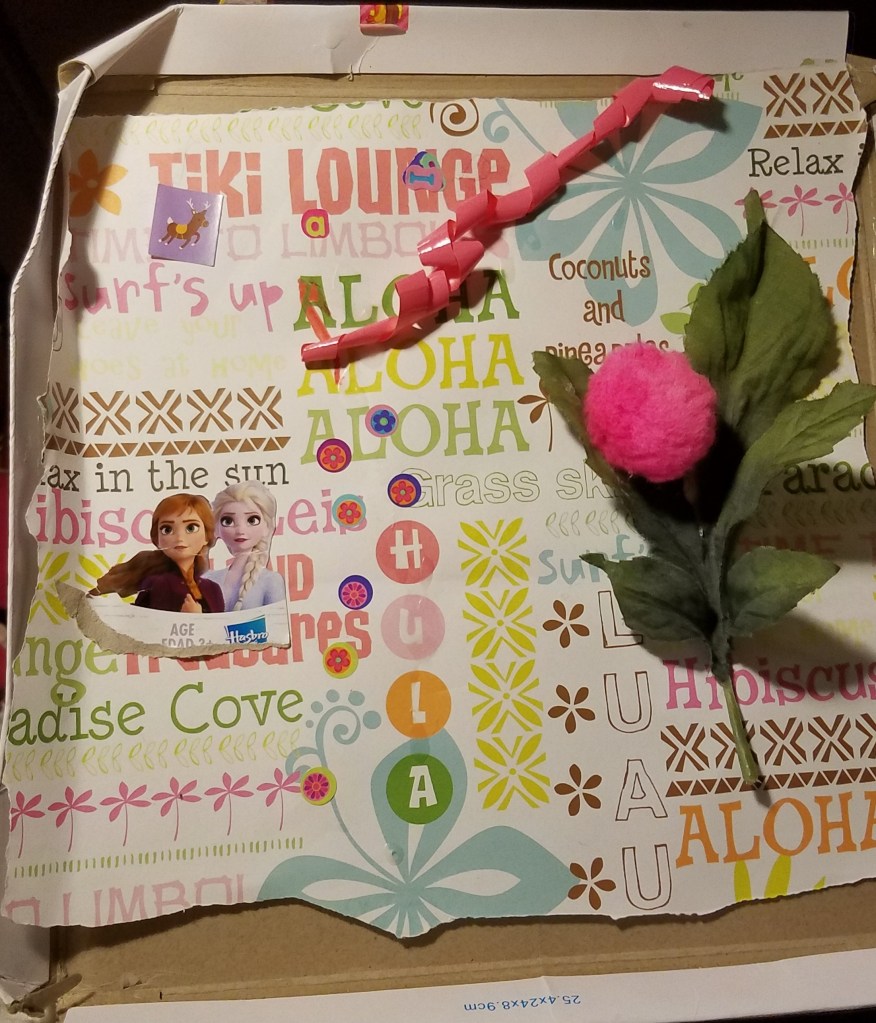
Below is the result of crafting together that day.
My vision board / collageMy preschooler’s collage
I tend to be a visual learner and have found vision boards to be powerful tools. I’ve shared this before, but years before I became a mom, I made a vision board about being a parent. My husband and I spent over a year trying to get pregnant before I had a miscarriage. I eventually became pregnant with my daughter almost a year after our loss. It was pretty amazing to look back at that vision board, even though my dream of motherhood took some time to materialize.
If you want to try your hand at making a vision board, below are some tips:
Review your goals or vision board from the prior year (or semester or quarter). Reflect on what you’ve accomplished and acknowledge your achievements!
Do you have any remaining goals that will continue into the next year (or another timeframe)? Do you need to remove some obstacles before you’re able to achieve these goals? Consider removal of a barrier to be an initial goal.
Think about your goals for your specified timeframe (year, semester, or quarter). What plans do you have for various areas of your life? You can focus on several areas of your life or many, but here are some to consider: work/career, finances, personal relationships, health/fitness, spirituality/well-being, education & development, rest & relaxation, or hobbies & fun.
Are your goals S.M.A.R.T. ? S = Specific, M = Measurable, A = Achieveable, R = Realistic, T = Time-bound. If not, design them to be S.M.A.R.T.
After you’ve thought about your goals (I also recommend writing them down in a planner or calendar!), gather supplies: paper, scissors, tape, glue, markers, and items with images you can use in your vision board (magazines, calendars, catalogs, or Pinterest photos/pins).
Start cutting out and collecting images or words that inspire you or remind you of the goals you have set for yourself.
Get at least one photo of yourself to place on your vision board. I also included pictures of my family in mine.
Assemble your vision board, making sure to include the year or goal timeframe (e.g. Semester I 2021) and a photo of yourself!
Place the vision board in an area you frequently see. I made my 2020 vision board and hung it on the wall by my desktop all last year. I replaced it with my 2021 vision board this month.
Before I made my 2021 vision board, I reviewed my 2020 vision board (per step 1 above). I posted my board last January on my FB and IG pages:
Upon review of last year’s vision board, it was reassuring to see how many things I accomplished or goals I achieved, despite a worldwide pandemic and various stay-at-home orders:
The photo of a mom and her newborn in my vision board was a nod to my much-anticipated maternal newborn and pediatric rotations. I got to attend an emotionally moving c-section birth as part of my maternal newborn clinical rotation last year. My classmate and I witnessed a father cry with overwhelming joy and love for his newborn child – it was so sweet that my classmate and I were both moved to tears. I got to complete my preceptorship in a NICU. I had wonderful experiences during my rotations.
I had a bunch of images related to nursing, education, and graduation. I graduated from nursing school with my BSN and passed my NCLEX last year.
I have “RN” and a pile of money on my board. I started my first job as a Registered Nurse before the year ended.
I have travel luggage, a camera, vacation views, and photos of families having fun doing various physical activities on my 2020 board. My family and I managed to squeeze in two family vacations last year – one to Solvang (thanks to a good friend’s timeshare) and another to Bishop (as a result of tagging along on my husband’s business trip). We did not travel the way I originally envisioned after graduation, but my family enjoyed ourselves and explored new places while safely adhering to health orders.
I have images from “Hamilton”, the musical. I had tickets to watch the musical in-person with my husband at the Pantages in May. The show was canceled due to the pandemic. Luckily, our theatre tickets were refunded. I had to be satisfied (but “I will never be satisfied!”, a la Angelica Schuyler) watching it on Disney+. A benefit with watching the musical at home is that my daughter gets to enjoy it, too. My daughter periodically requests Alexa to play the songs, particularly the ones sung by any of the Schuyler Sisters.
Before the pandemic, I was excited to be part of the graduating class of perfect vision, 2020. I remember being a total dork and declaring this to my classmates well before the pandemic became a reality. After the pandemic started, I forgot about being part of the class of perfect vision. Earlier this year, however, my church’s mothers’ ministry had a Zoom meeting challenging members to think about how 2020 was the year of perfect vision. It was interesting to consider: I had to be laser-focused in my commitment to my goals to avoid distractions and overcome the obstacles of an unexpected pandemic. And maybe 2020 had me re-focus and let go of attachments and what I thought my life should look like. My family did not travel to other states or countries for vacation as in previous years, but we got to experience adventure and explore new places locally and within the state. My daughter speaks fondly of Solvang as much as she does of Spain (we visited in 2019). Even with letting go of attachments and expectations of what I thought things should be like, I didn’t accomplish all my 2020 goals – I still need to add more physical activity in my life and to declutter my home – but looking at my old vision board, I’m proud of what I’ve accomplished in 2020! Now, onward to 2021!
Your friends are either a reflection of who you are or who you want to be. Ideal friends help carry you when you’re down and hold you accountable to being the best version of yourself. However, what if your friends doubt your abilities to obtain a nursing degree or succeed at something you desperately desire? I’ve had friends who have been either naysayers or cheerleaders in my life. Over time, I have learned to curate my friendships. After having a family and working full-time or going to school, my time is limited. How and with whom I invest my free time matters to me.
When I started taking my nursing pre-requisites, I had a friend share how her partner questioned my pursuit and wondered if I would go into Nursing. She said she defended me to her partner and responded that he doesn’t know me well enough to know how determined I am. While I appreciated her supporting me, I wondered why she even shared the story with me at all. You may have family or friends in your life who are not supportive or do not understand why you are pursuing a career change or nursing. You may need to limit the time you spend with them to focus on your goals. Limiting time with my friend with the doubting partner was not super intentional for me – I had little free time while I was doing pre-requisites and completing nursing school. I ended up not spending much time with many of my friends outside of school anyway.
Now that I’ve graduated from nursing school, I still don’t get to spend as much time as I wish with friends. Aside from the pandemic, circumstances such as friends becoming parents, moving, or job changes have made it challenging to coordinate schedules. However, I’ve learned I’d rather have a handful of close friends on whom I can rely rather than a ton of acquaintances or shallow friends. My relationships with close friends remain strong despite lapses in connecting with another or physical distance separating us. It doesn’t make sense for me to go out of my way to maintain relationships with people who don’t value me or my friendship or whose motives I question. I already have great friends with whom I do not spend enough time!
I was in a toxic relationship years ago, and a friend exclaimed, “There are so many people in this world! Why are you with someone nice to you only some of the time?” It’s been over 20 years, and that remark has stuck with me and helps guide me. Seriously, why invest time and energy in someone who doesn’t treat you well or support your growth and success? When I was younger, and my self-esteem was lower, I allowed people I thought were my friends to treat me terribly. I accepted friends who would insult and lie to me or were not interested in my wellbeing. They served as obstacles instead of contributors to my success. I am grateful to have grown and matured enough to recognize true friendship and to set better boundaries for myself.
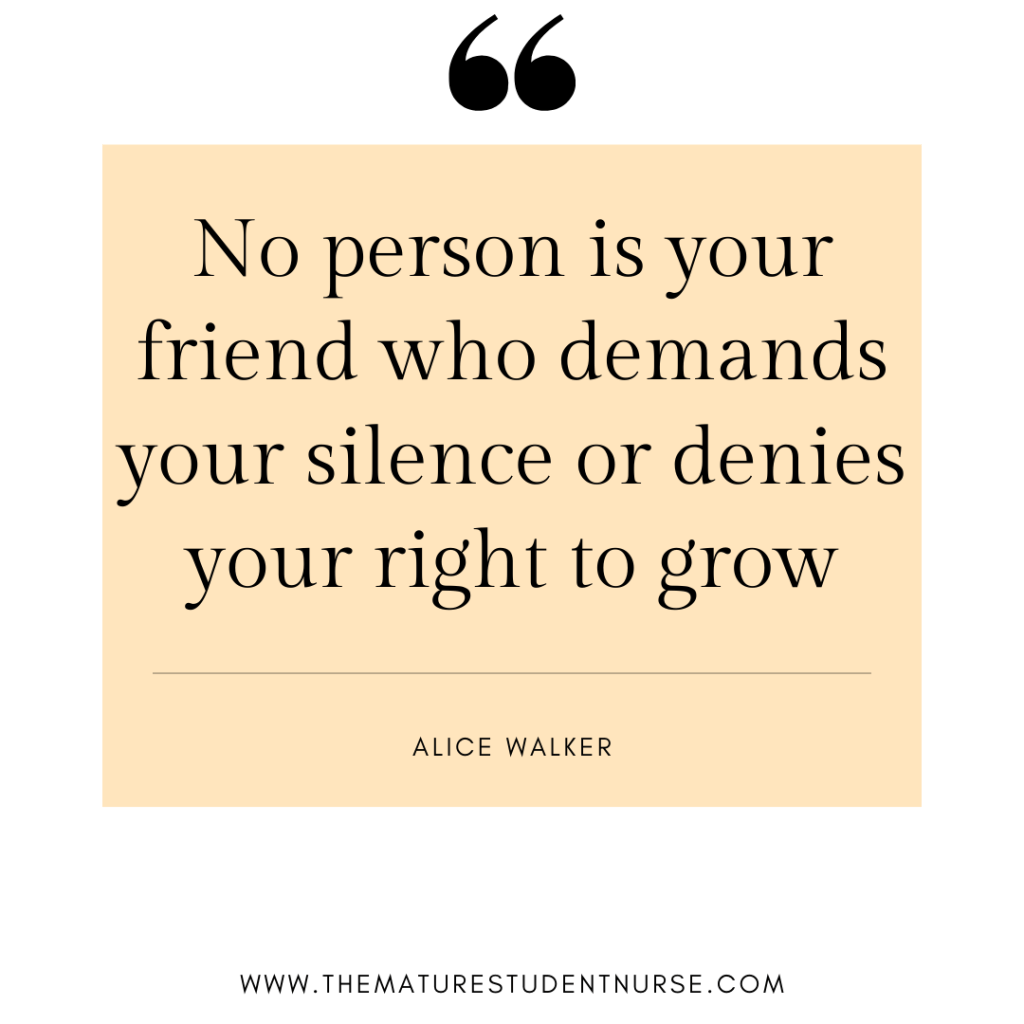
Decades ago, when pursuing my engineering degree, I had a planner with various inspirational quotes listed each week. A quote that stood out for me is from Alice Walker about friends: “No person is your friend who demands your silence or denies your right to grow.” Is someone who is not supportive of your career pursuits denying your right to grow? Have they shared any valid concerns? Or are they just tearing you down? Maybe it’s time to set boundaries and rethink your friendships.
I also like Alice Walker’s quote because it challenges me to evaluate my actions as a friend. In this time of passionate opposing views regarding the pandemic or politics, I’ve questioned if I need to remain friends with a person when I find myself wanting to block a friend or hide their posts from my feed. There should be mutual respect in friendships, and sometimes, I do not respect views expressed by some friends. I’ve wondered about some of my friends on social media, particularly when they don’t seem to be a reflection of who I am or aspire to be. If we were real friends, I would consider having a meaningful dialogue with them instead of silencing them. In the end, given my limited time and energy, I need to decide if the effort to maintain a friendship is worth it.
I remind myself of why we became friends. I consider how surrounding myself with only like-minded individuals furthers the divide I see in this country. So I continue to have friends or family in my social media feed whose political views I disagree with but who wholeheartedly supported me during my life’s milestones and career change. I’d rather be a person who builds bridges than walls. However, there are times when unhealthy, abusive, or toxic friendships must end. I think part of being more mature is developing the wisdom to know how and when to set boundaries.
Surrounding yourself with supportive people and good friends is vital, particularly during challenging or tumultuous times in one’s life. Friends do not always agree with everything you do or say, but they ultimately share your values or interests and respect you or care for your wellbeing. If friends disagree with what you are doing or oppose your pursuits – are their concerns valid? Are they voicing concerns because they care about you? Are they opening up your realm of possibilities, giving you a new perspective, or are they trying to keep you in your place?
One of the big reasons I pursued nursing is because a good friend challenged me. When I got laid off as an engineer and expressed interest in staying in engineering, he told me he’d help me but asked if it’s what I wanted to do with the rest of my life. He asked if I could see myself doing anything else. I took to heart what he asked, and I reflected, prayed, and did a lot of inner searching. His challenge and my resulting self-reflection are what prompted me to finally take action on my career change and go into nursing. I had thought about changing careers nearly a decade before but decided not to pursue it for various reasons. With my friend’s reminder and the new-found freedom I had from getting laid off and getting severance pay, I resurrected my dream to change careers. Good friends don’t always go along with what you say, but they help you be your best by providing a different perspective.
Good friends are there for you, not just in happy or triumphant moments but also in difficult moments. Nursing school brought me to tears more than once, and it helped to have good friends and family around me. When I doubted myself or my abilities, these good friends and family members listened to me and lifted me when I was down. Hopefully, you have good friends in your life. If not, seek out good friends. There is an abundance of people in this world – there is no need to choose friends who do not respect or appreciate you. I wish you good friendships and good luck for this new year!
Recently, I decided to cut back on the number of days a week I work. I recognize I’m blessed to have the option to work as many or as few days as a contract RN and COVID tester. Not everyone has the financial ability to work less. I know it’s a privilege to have this flexibility. Because I’ve spent my entire adult life working a minimum of 40 hours per week, I felt obligated to work full-time as a nurse in this pandemic, even though I have a per diem contract position.
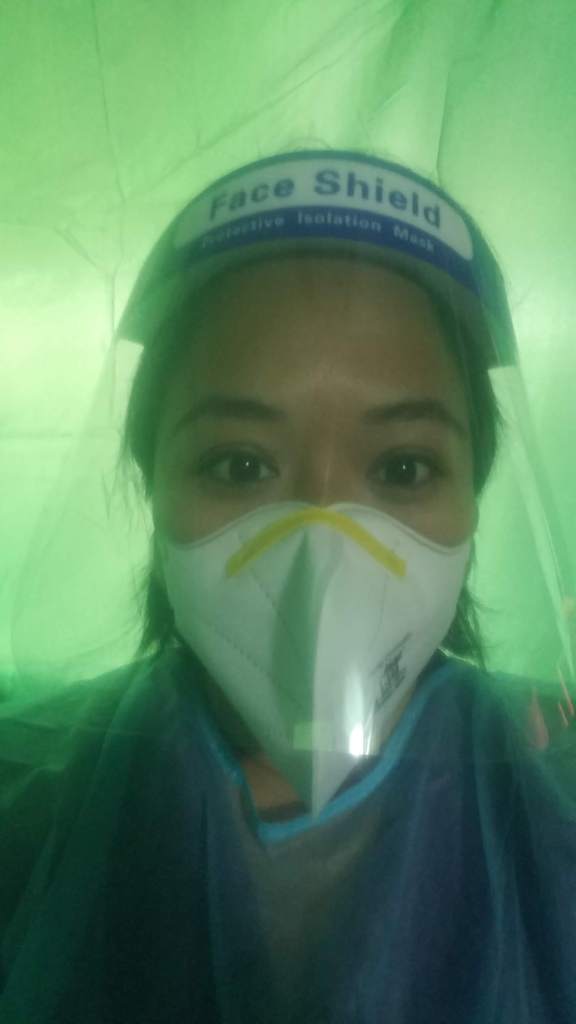
Me in my “uniform” during a typical workday.
I found myself exhausted after my five-day-a-week shifts and having to continually re-arrange my family’s schedule. I am a COVID tester for a studio. Due to ever-changing production schedules, I don’t often know what time I am to start work until the night before, and I usually do not know what time the workday will end my day has already begun. My start times last week ranged from 4:30a to 5:30a. My days ended anywhere from 2-4 pm. On days I work, my husband has to juggle conference calls while coordinating preschool dropoffs. If I don’t get out early enough, he also has to squeeze in pickups during his workday.
Besides worrying about my breadwinner husband adjusting his life to accommodate my work schedule, I began to worry about my physical well-being from working so much and being exposed to hundreds of people a week. During the past two weeks, four different nurses I work with called off work due to some illness or another. Other people seemed tenser because they discovered more people in their work or personal life had come down with COVID.
Since Thanksgiving, I get tested for COVID every day I work. I appreciated the daily tests confirming I didn’t have COVID but realized my body was feeling worn out. Even though I’m naturally an extrovert, I didn’t understand how exhausting it can be to serve hundreds of diverse clients every week. My unpredictable work schedule was also adding to my daily stress. One day I was so tired after work, I think I fell asleep on my way home at a stoplight. I know driving drowsy is extremely dangerous – I didn’t realize how tired I was.
One of the nurses I worked with is a retired hospital nurse. She is a seasoned nurse who now works per diem for “fun” during her retirement. She shared that when she was younger, she always volunteered to work overtime. It resulted in her developing hypertension and needing medication. Since then, she has become an advocate for self-care and setting healthy boundaries. In addition to her, I’ve heard similar messages from bloggers I follow: Do not do things out of obligation or because it’s what you think others expect of you. Do what is best for yourself.
Despite my co-worker’s advice, I didn’t consider cutting back on the days I worked until a friend suggested it. During a phone call, she commented on how tired I sounded and heard my increased anxiety about people around me getting sick. After some thought, I requested fewer days from my boss this past Sunday. This week was the first week I didn’t work five days in a row! I felt guilty at first. However, as COVID cases and deaths rise here in Los Angeles, I feel more secure in my decision. I’ve also had more patience and energy for work and home since I’ve had more days to rest this week.
Nurses in hospitals are overwhelmed and have contacted me to let me know all their units are short-staffed. The patient loads are high and over ratio. New grads are getting pulled off orientation to help. As much as I feel like I’m struggling to get a hospital job right now, it seems like a blessing I don’t have one. I’m frustrated and relieved at the same time. I’m glad I get to work as a nurse and contribute somehow, but I’m also thankful that I’m not like my friends and family working in hospitals witnessing the COVID deaths and raging illness. They are frustrated when they see or hear about people not following public health orders to wear masks or avoid social gatherings because they suffer the consequences in a more profound way than the general public.
To all healthcare workers right now, particularly those in hospitals, I am praying for you and grateful for you. I hope you are protected and supported and able to do what you need for self-care. I hope this vaccine is effective and able to remove the burden of worrying about getting COVID or bringing it home to your loved ones. I am doing what I think is best to ensure my family or I do not add to your patient ratios. I’m trying to keep myself safe and healthy so that I may be part of the care team in a hospital someday soon! It took a while to be aware of my own needs, but I have cut back on the days I work for my well-being. For everyone reading this, please practice self-care and keep yourself safe!
Thanks to an upsurge in COVID cases in Southern California, we have new stay-at-home orders in effect starting today. The Health Department does not recommend co-mingling or going to parks with other households. Playgrounds have shut down again. Dining at restaurants – even outdoors – is not allowed. As a parent, it’s sometimes hard to explain the changing rules to my preschooler. I’m a nurse trying to adhere to public health orders, but I’m also a concerned wife, daughter, and mother who wants to protect my family and loved ones from COVID. I found some complimentary child-friendly resources that explain COVID, hand-washing, mask-wearing, and social distancing. I’ve used them with my daughter and thought I’d share them here.
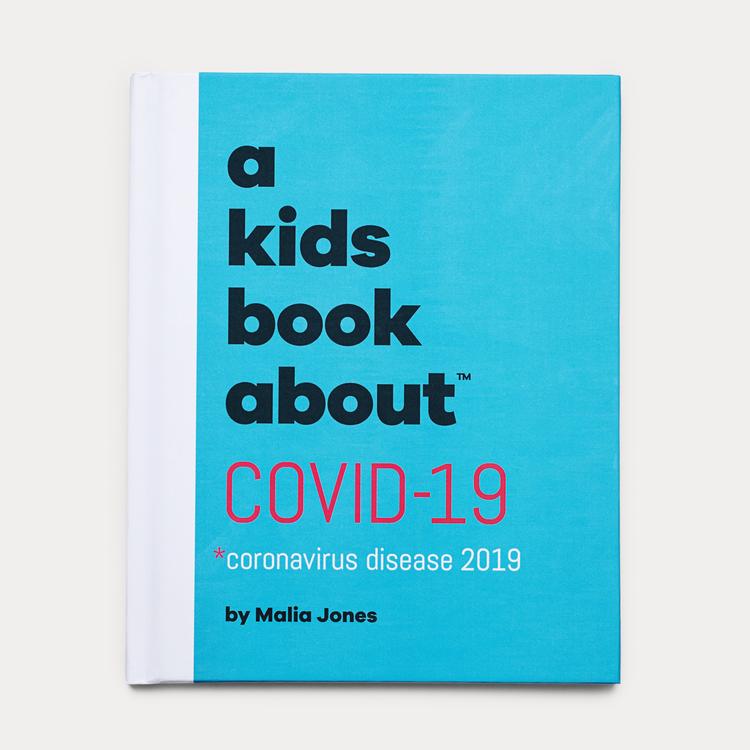
At the beginning of the pandemic, the series of books “A Kids Book About”… offered a free e-book “A Kids Book About Covid-19” by Malia Jones. It is still available for download here: https://akidsbookabout.com/products/a-kids-book-about-covid-19. My daughter and I read the e-book together, which helped her better understand social distancing and hand hygiene. (“A Kids Book About” offers other great books that help discuss complex topics such as death, cancer, and racism with children. I encourage other parents to check out the series)!
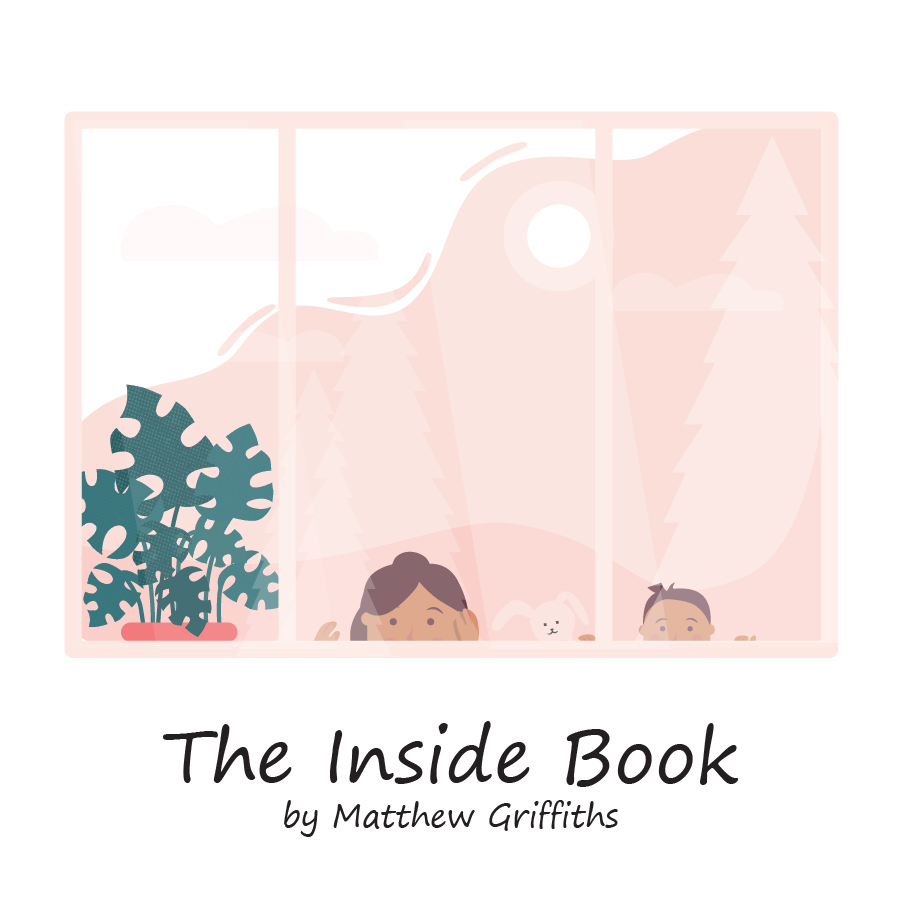
Another great book, also free, is “The Inside Book” by Matthew Griffiths. There’s graphics at the back of the book explaining handwashing, mask-wearing, and how to cover a cough or sneeze. This book is offered as a free download in various languages on the author’s website, https://mattcgriffiths.com/. There’s also an animated reading of the book at the same website and on YouTube.
On YouTube, the Dr. Binocs series offered by Peekaboo Kidz helps explain coronavirus and other science-related topics. (I discovered the series when I tried looking for kid-friendly information about pinworms. There was a pinworm outbreak at my daughter’s school a year ago, and I couldn’t find any preschool appropriate resource to explain it to my daughter)!
Life is hard enough to navigate during a pandemic. As a parent, it’s nice to have free tools to explain this pandemic and public health recommendations to my daughter (or younger patients)! I think these free resources above would be great to use for pediatric patient education. If you have other pediatric resources you use, please share! I would love to learn about them! Stay healthy and safe, friends!
Things have been hectic for me this week because I started a new job on Monday! I am a COVID tester for a studio! Hollywood studios have resumed filming and frequently test their cast and crew to ensure people do not have or spread COVID.
I found out Sunday night I got the job and was expected to work at 3:30a the next morning in a city about 45 minutes from my home (without traffic). I scrambled Sunday night searching for scrubs to purchase in-store, laundering them later at home, applying for professional liability insurance, reviewing, signing, submitting paperwork, and reading the policies and procedures manual. I also had to complete and submit an application for a new grad program due that same Sunday. I was up until about midnight and out the door by 2:30a. I was tired but running on adrenalin! I am like a substitute teacher – I don’t know where I’m going or what time I’m working until the afternoon before each workday. It’s been a whirlwind for me since Monday!
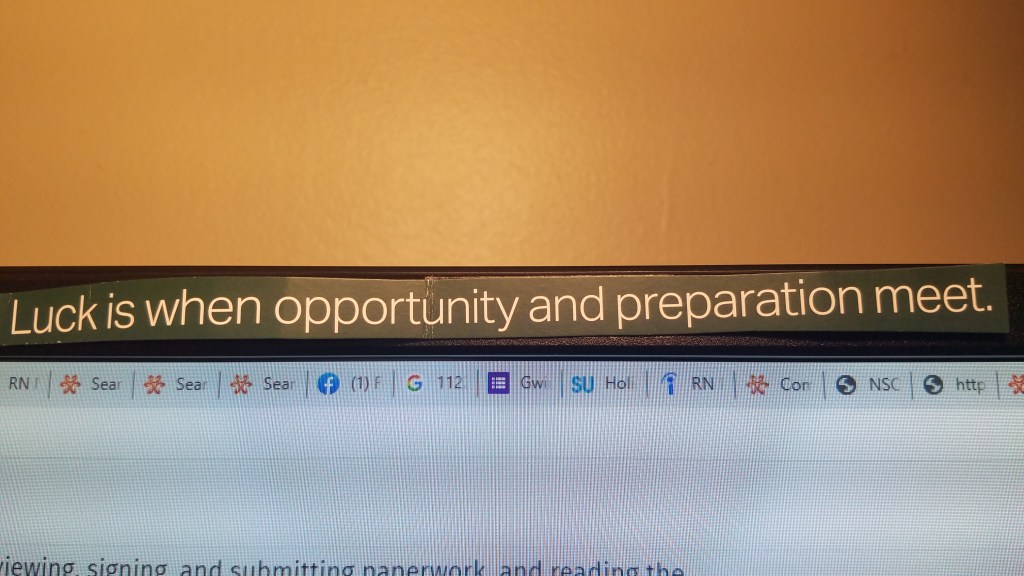
My former classmate referred me to my current job. I am lucky that I have such a supportive cohort – we frequently share new grad job opportunities. (TIP: Keep in touch with your classmates, even after you graduate)! He texted our cohort one afternoon. I immediately sent my resume to his contact, and I received a phone call less than a week later! It helped that I updated my resume and was prepared since I had been applying to new grad positions. It’s luck that I got this job, but “Luck is when opportunity and preparation meet.” A year ago, I found this quote, cut it out, and have it posted on my computer monitor as a reminder.
I encourage you to keep striving for your goals. Stay prepared, move forward, and use opportunities as they come along as stepping stones toward your ultimate goals. It’s funny how this opportunity came along just after I posted about rejection and failure last week. I don’t think it’s by accident; maybe I needed to lead by example. When you feel down and as if you’re not moving towards your goals, pick yourself up, and keep striving! Most importantly, when you lift yourself up, take others along with you!
For Christmas last year, I bought tickets for my husband and me to watch the musical “Hamilton” in Los Angeles during my semester break scheduled in May. I figured it would be a nice treat for us before my last nursing school semester. That was until the pandemic hit and canceled the show. While I was disappointed, I agreed with the CDC recommendations and state orders not to have large indoor gatherings. I figured I had already waited years to watch the show; I could wait a little while longer to enjoy it safely at a later time.
Once summer arrived, I was excited to learn that I could watch “Hamilton” from home on Disney+. However, I didn’t allow myself to subscribe to the streaming service until I graduated because I didn’t want to become distracted from studying. As a mini graduation gift to myself, I subscribed to Disney+ to watch “Hamilton” in August.
I know I’m years behind, but I finally watched and loved the musical, “Hamilton”! My preschooler has grown to love it too and will ask to play songs from the musical. She loves and will continuously replay the “The Schuyler Sisters,” “Satisfied,” and “Helpless.” Personally, “Wait for It” appeals to me. While “Wait for It” is the song of the musical’s anti-hero, Aaron Burr, I can identify with the feeling of waiting.
My favorite part of the song, “Wait for It” from “Hamilton”
Waiting to take the NCLEX
Life after nursing school requires a lot of patience. It’s almost anti-climactic to spend all this energy in an accelerated nursing program and graduate only to wait in what feels like forever to get permission from the nursing board to take the NCLEX. While other classmates’ accounts showed they conferred their degree soon after the semester ended, I had to wait for my transcripts to show I graduated weeks afterward. About a month after graduating, some of my classmates sat for their NCLEX; I still hadn’t received my authorization to test (ATT) from the testing company. I grew anxious and started to feel like I was on hold, waiting for my life to begin while everyone else was moving forward. I had to remind myself that my life was already in motion, and I had accomplished many of my life’s goals. I could choose to be content with my life as it was or wait for some external factor (like an ATT) before allowing myself to feel content.
I received my ATT about a month and a half post-graduation. I gave myself a little over a week after receiving my ATT to study and take my NCLEX. Passing the NCLEX took a lot of weight off my shoulders and made me eligible to apply to many more jobs. However, after passing the NCLEX and becoming a registered nurse, I continue to wait for: new graduate positions to open, status updates to job applications, and recommendations or replies to recommendation requests.
Waiting for a job offer
As an unemployed nursing graduate, I miss being in a clinical setting and am eager to return. I often feel like I’m not a real nurse since I’m not working. I want to work but don’t qualify for many RN jobs since I’m a recent graduate who hasn’t worked in an acute setting. I want a new grad position so I can get proper training as a novice nurse. However, I don’t want a new grad position doing any type of nursing in any setting. I am a second-career nurse. I evaluated my skills and desires to change careers, and I know I want to work in a specialty. I want to either start in that specialty or start in a role with a clear path leading me to it. I’m older, and I don’t want to waste time. I’m willing to wait a little while for a good opportunity for myself instead of broadly applying to jobs I don’t want.
While I wait for my first RN job, I am preparing myself for my career. I studied and took certification courses for PALS (pediatric advanced life support) and NRP (neonatal resuscitation program). I reached out to early-career and mid-career nurses to ask them about new grad programs and what it’s like to work in various hospitals. I revised and had people review my resume. I targeted specific people for recommendations for different job applications.
Even though I’m unemployed, I know I’ve done and continue to do what I can to prepare for my nursing career. Knowing how to delay gratification and wait for things allows me to enjoy my free time. I’m satisfied with the work I put in during school and after graduation. I don’t feel guilty when I take breaks from studying for certifications or job hunting; I genuinely enjoy myself. I get to explore Los Angeles and venture into areas I hadn’t seen before or finally watch shows I put off watching. The pandemic has put travel plans and trips to visit family and friends on hold, but I’m willing to wait for it. I can have fun doing other things while I wait to get a job (#funemployment).
Waiting as a skill
Learning how to wait while preparing and working toward your goals is a life skill. Like any skill, it may take some practice before you are good at it. For example, I decided to watch “Black Panther” the day before an Anatomy & Physiology midterm because it was opening weekend, and I figured I could study afterward. I loved the movie, but the pre-test movie resulted in a low midterm grade. It such a drop from my usual scores that my professor asked me what happened. I couldn’t admit to him that I watched a movie instead of studying the day before. I felt terrible that I jeopardized my prerequisite GPA to watch a film I could have easily watched another time. Luckily, I recovered; my prerequisite GPA was good enough to get accepted into competitive nursing programs. I did something similar again in nursing school. Eventually, I learned my lesson, which is why I refused to subscribe to Disney+ until after graduation. When I feel burnt out from studying, it’s too easy for me to feel like I need to escape, de-prioritize school, and take an overly long break. I realized my long-term goal of becoming a nurse was more critical than watching a long-awaited musical (and maybe I needed more frequent breaks and rewards for myself so that I wouldn’t feel burnt out)!
We need the recognition that some things, whether it be goals or skills, take time to cultivate. Learning how to prioritize and determine what needs immediate attention versus what can wait is as much a life skill as it is a nursing skill. It takes years to become a nurse. Sometimes, especially during prerequisites, it felt like I was getting nothing done since I was spending all my time in school and studying but had no degree or job to show for it. I could only hope all my efforts would lead me to my ultimate goal: a working RN. I’m still working towards my goal but appreciate that while waiting to become a nurse, I developed new skills, made new friends, and pushed my limits of what I thought was capable. Waiting has given me time to prepare and develop into the person I need to become a nurse. I’m still waiting to become a working nurse, but I know I haven’t wasted my time.
Waiting as a parent
Similarly, as a parent, life requires a lot of waiting and unknown. My husband and I can only hope that the love and attention we give our daughter leads her to be a smart and decent person with a happy, healthy life. I love what my doctor shared with me about parenting, “We can cultivate and fertilize the soil, but who knows what will take root and grow?” Even if I weren’t pursuing a second career, having a child demands patience and waiting. Have you ever had to deal with a toddler insisting on putting on their shoes or clothes? Or waiting for them to pee on a potty? Trust me – Parents understand waiting! I now have more patience and grace for myself because I continuously practice patience and grace with my child.
Wait for It
The “waiting” we do in life is often the journey to our destination. We can feel stuck in “waiting” or allow for growth and development to occur. In some ways, the waiting is fun – it’s an unfolding of a story, a discovery of who we have yet to become; it implies potential. If you ever think you’re stagnant and waiting for life to happen, know you’re not alone. I feel this way from time to time. Sometimes, we need a little reminder of the power we have over the choices we make. You are the only thing you can control, so set your priorities and do what you can to move towards your goals. Other times, we need a little encouragement. When I’m doing what I can but feel I am not getting the results as quickly as I want and start to doubt myself, I remind myself of the lyrics from “Wait for It”: “I’m not falling behind or running late. I’m not standing still – I’m lying in wait”.
Last month, I convinced a former nursing school classmate to join me in giving blood. She had never donated before, so I was so excited for her, but I was also happy someone was willing to join me! Is it sad that the only time I feel I can be “social” during the pandemic is when I’m doing things like going to school or donating blood? If you’re like my friend and have never given blood or wonder what blood donations are like during a pandemic, this post is for you!
Donors receive gift cards and discounts.
Aside from supporting someone else’s life, donors got perks such as gift certificates and discounts to restaurants or retailers like Amazon. Depending on the blood drive, donors can be entered into prize drawings or receive items like water bottles. Donors typically get water, juice, and snacks after their donation, too. Recently, the American Red Cross announced they would test blood donations for COVID antibodies – this free antibody test is a significant new perk in donating blood!
Blood donors get free COVID-19 antibody testing.
My friend and I were both eager to get the COVID antibody test for free. We knew of healthcare workers and personally worked with a nurse who showed no COVID symptoms but tested positive for antibodies. “Antibody testing may indicate if the donor’s immune system has produced antibodies to this coronavirus, regardless of whether an individual experienced COVID-19 symptoms. A positive antibody test result does not confirm infection or immunity” (redcross.org). Regardless, we wondered if we would have positive antibody results and secretly hoped we were one of those asymptomatic people with possibly protective COVID antibodies.
Make a donation appointment early – appointments fill up quickly.
Before the pandemic, many blood drives accepted walk-in donors without appointments. Now, anyone donating must make an appointment ahead of time. Many drives fill up for several weeks or even a month in advance.
There are many blood drives – make an appointment for a location/date/time convenient for you.
We found a blood drive and made a donation appointment at a beachside hotel in Marina Del Rey, here in Southern California. I decided to pick this hotel in particular, because I liked their restaurant and knew they had a scenic outdoor dining patio. I figured I could brunch with my classmate as a mini celebration to her inaugural blood donation but also to us graduating from nursing school. We had not celebrated our graduation together in-person due to the pandemic. We had spent enough time together at clinicals and lunch breaks in hospitals during the pandemic, however, that we thought an outdoor post-graduation brunch would pose minimal risk.
The blood drive was at a hotel right on the marina. It was in a ballroom with windows overlooking the beach, in an area separate from their dining patio.
Save time and use RapidPass for pre-donation reading and screening.
To save time completing questionnaires and screening questions before the actual donation, donors can answer health history questions and complete the pre-donation reading using their computer or mobile phone the day of the donation via the RapidPass application. Travel, medications, and certain kinds of activities may make people ineligible to donate blood. Doing the pre-donation reading via RapidPass may help a person discover whether they should donate blood before showing up to a blood drive.
I used RapidPass (https://www.redcrossblood.org/donate-blood/manage-my-donations/rapidpass.html) to minimize the amount of time I had to sit and wait in a room filled with strangers. While appointments ensure spacing between donors and minimal crowding, I still felt uncomfortable at the prospect of spending an hour in an indoor, enclosed room with random people. (I don’t know why, but I never had this concern during clinicals at hospitals. Maybe it’s because I had to be at my clinicals, but blood donations are entirely voluntary). Upon arrival, I showed the registration volunteers my photo ID and RapidPass confirmation barcode. After that, it was a quick process for the temperature and hemoglobin screening before my actual blood donation.
Wear a mask. If you are sick, visit a doctor or stay home.
The American Red Cross requires blood donors to wear a face cover or mask and keep their mask on upon their arrival and during their appointment. They also screen donors to ensure they are not running a fever or exhibit other symptoms. My temperature was taken twice by two different people before I gave blood. The registration volunteers asked me to use hand sanitizer, and everyone wore masks and displayed proper hand hygiene. I appreciated all the precautions during my appointment.
Although donors get free COVID antibody screening, if people are sick or have COVID symptoms, they should get screened for COVID and diagnosed elsewhere. “The Red Cross is not testing donors to diagnose illness, referred to as a diagnostic test” (redcross.org). If I had an active infection, I wouldn’t want to risk exposing blood drive volunteers, staff, and other donors to my illness, even if I thought it was only a cold. I would hope others would do the same and quarantine themselves according to CDC recommendations if they were sick.
Hemoglobin levels will be tested and must be normal.
Before every donation, the American Red Cross gathers a drop of blood by pricking a potential donor’s finger and tests that sample for hemoglobin levels. The process is very similar to the point of care glucose testing I did during clinicals. I tried giving blood in August but could not since my hemoglobin levels were too low, which was likely caused by low iron.
Because the American Red Cross no longer accepts walk-in appointments, anytime a potential donor is turned away from giving blood that same day, the Red Cross cannot quickly fill that newly-vacant appointment. The pandemic has severely impacted the usual avenues of blood drives at schools, offices, or churches since these groups have not been meeting in-person or on-campus. To ensure I could donate and not waste a donor spot, I decided to take some iron supplements a week before my September donation appointment. Luckily, it raised my iron levels high enough that I was able to donate blood. I only needed one finger prick to show my hemoglobin was within normal limits! There have been times when I required a second sample to qualify as having normal hemoglobin levels. Or, like in August, the second sample confirmed that I was below normal limits. (For additional information about iron levels and blood donations, check out: https://www.redcrossblood.org/donate-blood/blood-donation-process/before-during-after/iron-blood-donation/iron-informationforallblooddonors.html)
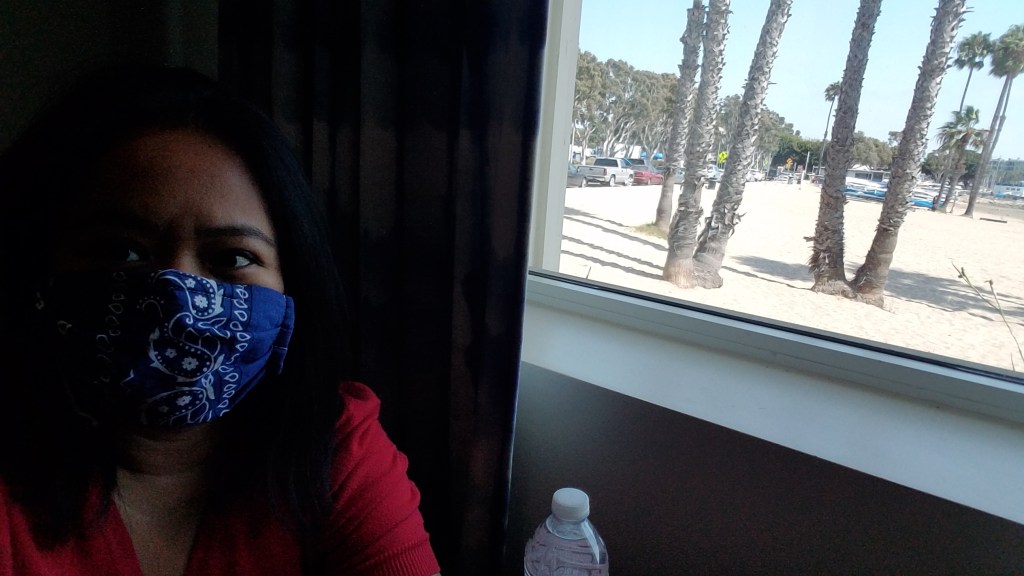
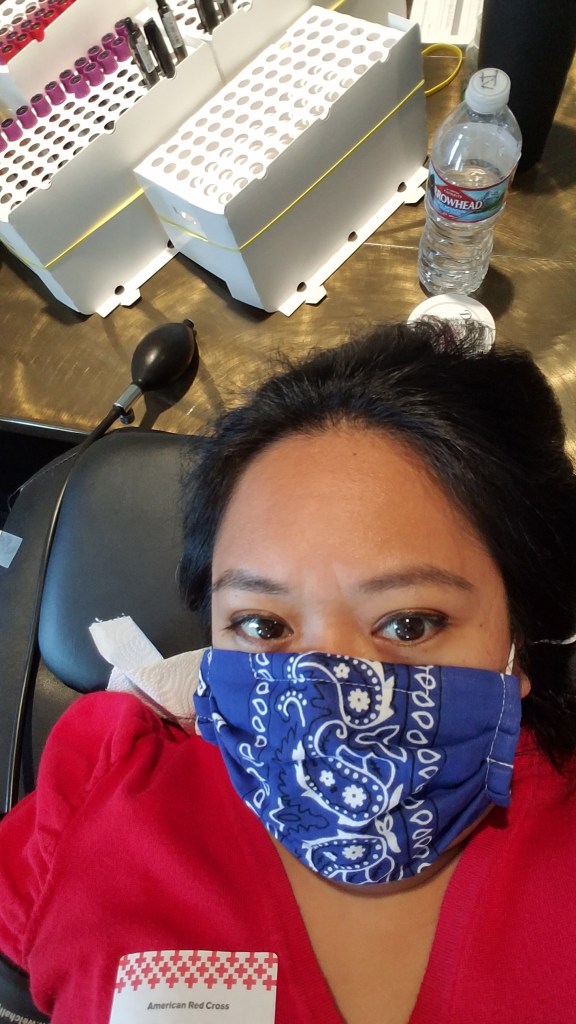
Masked and lying down while donating blood.
After all the screening questions and tests were complete in a makeshift cubicle area, the staff person led me to the room’s blood donation section. While you donate blood, you lie on a cushioned table that is as comfortable as the doctors’ offices’ exam tables. I was fascinated by the venipuncture and blood donation process and asked the person who collected my blood if she had any tips. Unlike some of my personal experiences during nursing school, she was confident in poking me and didn’t struggle to find a vein. Poking people all day for the past ten years made her skilled at venipuncture – I hope to be just as confident and proficient someday! (Tip: go for a vein you can feel, not one you can only see)
Full transparency: the collection needle is big.
I will not lie – seeing the needle they used to collect my blood was a little intimidating. I had never been afraid of giving blood before, but it had been a while. I had never seen or used a needle that huge (16-17 gauge) on a person or mannequin in all of my nursing school! The needle they used reminded me of a draw needle (used to draw up medication from a vial, typically more massive than any injection needle I ever used on any patient). Because a pint of blood is needed instead of merely test tube quantities, the collection needle needs to be big enough to allow for decent blood flow. Otherwise, the donation process would take much longer.
Once the needle is in, it typically takes no more than 10-15 minutes to donate blood. Some old co-workers I know would try to race each other and see who could fill up the bag and donate the fastest. I think their donation took only 3-5 minutes on one occasion. However, I was in no rush and was honestly just happy to be out of my house and around people.
What my arm looked like later that evening, after removing the bandage. I got a minor bruise at the puncture site. This small bruise didn’t hurt and disappeared after a couple of days.
After the actual donation, prepare to rest for 10-15 minutes before leaving
After my donation was complete and they bandaged me up, they invited me to sit and relax in the snack area . There is usually a table of juice and snacks like granola bars, trail mix, or crackers and cookies at every blood drive. Donors are encouraged to sit and rest and snack on something after their donation, before they leave. This also allows the staff to observe donors for any reactions to the donation.
I had a friend who wanted to skip sitting and resting after her donation and ended up fainting as she walked out the door. If you feel light-headed after donating blood, sit down and let someone know! Blood loss and dehydration can cause people to experience orthostatic hypotension or dizziness upon standing or changing positions.
It’s essential to hydrate just as much after a donation as much as it is before donating blood. The hotel restaurant was having a happy hour in their outdoor patio that afternoon. As tempting as it was (I haven’t been to a happy hour since before the pandemic), alcohol is not recommended after donating blood. I stayed hydrated!
Snack selection and view after my blood donation. In addition to my snacks, I got to appreciate a clear sunny day, palm trees, and a beach view for my blood donation
You may need to modify activities after your donation.
Like alcohol, strenuous exercise is not recommended the same day after donating blood. If you think you need a high-intensity workout the day of your donation, do it before giving blood. Years ago, when I had daily running routines and ran marathons, I would schedule my workouts before donating blood or use a donation day as a rest day. Give your body at least the evening to recover from donating before resuming working out heavily. [Un?-] fortunately, regularly working out hard-core is not something I’ve been doing recently, so I didn’t have to reschedule anything.
I’m not eligible to donate whole blood again until next month; I plan to donate once 56 days have passed since my last donation. My friend wants to do it again, too. Donating blood helps replenish an impacted blood supply. It is an easy, smooth process, I get to ask highly experienced professionals about venipuncture tips to support my nursing practice, and I get to invite friends to join me! Plus, my friend and I like the idea of regularly getting a free COVID-19 antibody test!
I’ve been scarce here because I took the NCLEX last week. I was busy studying and preparing for the NCLEX. The NCLEX is the national exam that nurses must take to gain licensure. Nurses cannot practice nursing or work as nurses without their license; it’s what makes a nurse a “registered” nurse.
After impatiently waiting, I received my authorization to test from the testing company on Monday, September 14, at 9:47 pm. I took the NCLEX for the first time on Thursday, September 24, at 1:00 pm. I wanted to give myself at least two weeks to study. However, I was anxious to take the NCLEX before the end of the month because a job application was closing on September 28. Additionally, starting on October 1, the minimum number of exam questions would increase from 60 to 75. I studied as much as I could in those ten days, taking a day or two off to say goodbye to a good friend who suddenly decided to move across the country. It would have been nice to focus solely on studying, but life happens even as we make plans.
On the day of the exam, my friend/old classmate/neighbor walked with me to my testing facility. Just a couple of weeks before, I had done the same for her when she took her NCLEX. I hadn’t received my authorization to test when so many of my classmates got to take the exam. It was finally my turn!
I took my time with the exam and spent over an hour answering the items presented to me. My computer shut off at 60 questions, the minimum number required to pass the NCLEX. I was relieved when it shut off at 60 questions since I knew the computer-adapted exam could be much longer. The four practice exams I took and passed also shut off at 60 questions. The one practice exam I took and failed reached the maximum of 130 questions before shutting off. I felt the computer shutting off at 60 questions was a good sign.
Me, right after the NCLEX, outside the testing facility, crossing my fingers that I passed!
The testing company does not share official results until 6-8 weeks after the exam. However, in California, nursing licenses post as little as two days after an NCLEX is taken and passed. License numbers are issued by the Board of Registered Nursing and listed publicly by the Department of Consumer Affairs. My friend shared she could search and find posted license numbers as soon as midnight, two days after an exam. I decided to look up my name on Saturday, September 26, shortly after midnight. My parents and husband were with me as I tried to search for my name. The video below is my recorded reaction.







 The Mature Student Nurse