Vasovagal Syncope at a Mass Vaccination Clinic

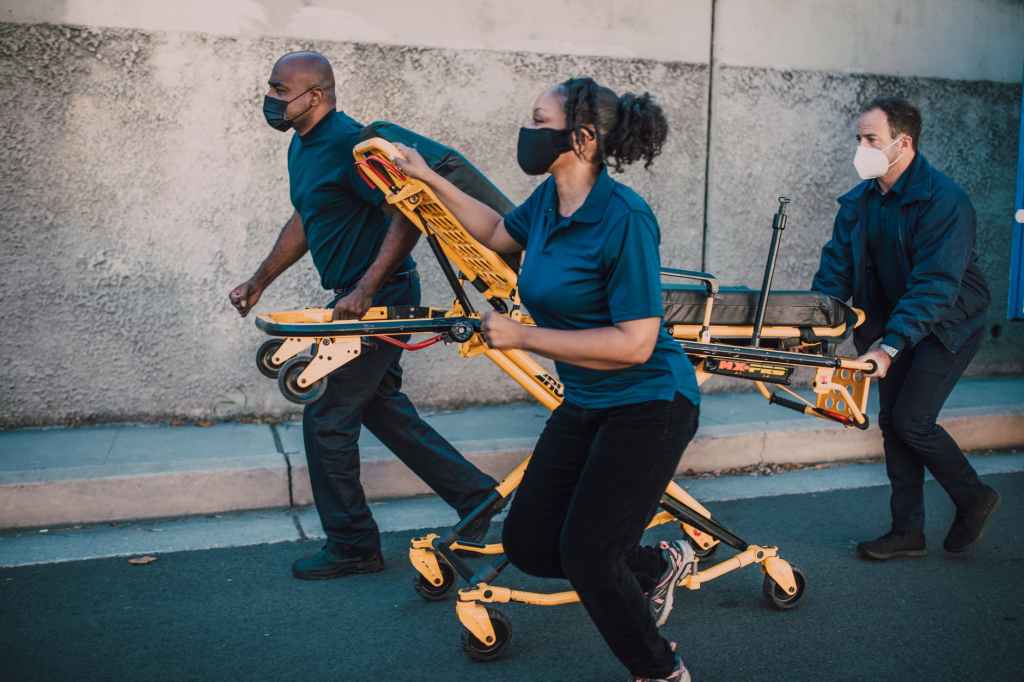
Photo by RODNAE Productions on Pexels.com

I was at a week-long pop-up mass vaccination clinic last month in the parking lot of a sports stadium. We monitored patients for severe allergic and other adverse reactions after administering their vaccine injections. Luckily, we never encountered any patients needing us to treat them with an epi-pen in our tent. However, we did have a patient who fainted almost immediately after receiving their shot. The patient eventually regained consciousness, but not before being attended to by at least five nurses with medics and a doctor along the way. If a patient is going to have an adverse reaction to the vaccine, having one at a mass vaccination clinic prompts attention from an entire team of healthcare professionals!

I had never experienced a person fainting before and it was actually impressive to see so many experienced nurses quickly react and attend to the patient. I didn’t give this particular patient their shot. I didn’t even see the patient faint, since I was opposite end of the tent when it happened. I turned around from where I was and all I saw was a bunch of nurses rushing to care for this patient. Everything happened so quickly. As a new nurse, I want to share what I learned and saw so I don’t forget and can apply it to my own nursing practice!

What is Syncope? What causes it?

Fainting, or syncope, is caused by reduction of blood flow to the brain resulting in a momentarily loss of consciousness. With vasovagal syncope, this can be caused by a sudden drop in blood pressure due to dilation of blood vessels or decreased heartrate. Without knowing this patient’s full medical history, our patient’s syncope was likely an anxiety-provoked reaction to receiving the shot. Some people faint at the sight of blood, pain, or other stressors. It is thought this patient was so anxious about receiving the shot, that the patient fainted and had a vasovagal syncopal episode. I did not follow this patient back to the medic tent where the patient was further monitored and assessed. I also did not administer the shot, interview the patient, or provide the patient with the disclosure statement for verbal consent, so I have no idea if this patient has fainted before. However, what I’ve learned is if a person has a history of fainting, it is recommended for the patient to recognize what provokes the fainting (to avoid or work around triggers) and to also get a medical examination to ensure there are no other health conditions causing syncope. After our patient who fainted, we had a number of patients expressing a history of fainting after vaccinations, so we monitored them more closely and had them sit or lie down after the shot. Luckily, no other patients had a syncopal episode.

A-B-C Prioritization Always Applies

In prioritizing patient care, a nurse assesses a patient and prioritizes airway, breathing, and circulation. This is often referred to as the ABCs.

“A is for airway assessment, observing for airway obstruction which can be seen with a changed sound of voice, “see-saw” respirations, and stridor. B is for breathing assessment, observing for an abnormal respiratory rate, the use of accessory muscles for respiration, and cyanosis. C is for circulation, observing for color of hands and digits, an abnormal capillary refill time, and decreased level of consciousness (LOC). “

Picmonic.com

The patient was sitting when they fainted, and some nurses pulled the patient down from their seated position, in their wheelchair. Other nurses rushed to support the patient’s bottom, legs, and feet. After the event was over, some of the nurses wondered why the patient was pulled down from their wheelchair. After an internet search, I learned one should help a patient lie down and elevate their legs to encourage blood flow to their brain (https://www.mayoclinic.org/diseases-conditions/vasovagal-syncope/symptoms-causes/syc-20350527).

Vasovagal syncope most often occurs when a person is standing or sitting (https://www.cedars-sinai.org/health-library/diseases-and-conditions/v/vasovagal-syncope.html). Supporting a patient in the standing or sitting position while they have fainted can prolong their unconsciousness and decreased blood circulation to their brain – their blood will continue to pool in their lower vessels. The nurses pulling the patient down from the seated position were trying to improve circulation. The patient did not have a blocked airway and was able to breathe, but had fainted. The nursing intervention of changing the patient’s position was prioritizing circulation, the “C” part of A-B-C prioritization [Airway – Breathing – Circulation].

Techniques to Regain Consciousness

Because the person fainted, the person was unresponsive to verbal commands or requests. I saw a nurse perform the sternal rub in an attempt to “wake” the patient. Luckily, the patient regained consciousness after laying down and getting the sternal rub. Once the patient recovered from fainting, the patient was frightened and did not seem to understand what had happened. The startled patient grabbed at the nurses’ hats and clothing. It’s normal to be confused after fainting. The patient’s caregiver verbally reassured the patient that they were okay. By the time the patient regained consciousness, the medics from the medical tent had arrived accompanied by monitoring equipment and a doctor. The patient was calmed down and taken to the medic tent for further monitoring and observation.

It was not used, but there were ammonia sticks in our supply bin. These smelling salts can be used on a patient who has fainted, in an attempt to increase oxygenation to the brain. In the British Journal of Sports Medicine article, “Smelling Salts”, the author explains:

“Smelling salts are used to arouse consciousness because the release of ammonia (NH3) gas that accompanies their use irritates the membranes of the nose and lungs, and thereby triggers an inhalation reflex. This reflex alters the pattern of breathing, resulting in improved respiratory flow rates and possibly alertness.”

McCrory, P. (2006)

An experienced nurse shared with me that if the ammonia sticks or smelling salts are unavailable, alcohol wipes can also be used under a patient’s nose in an attempt to startle them into consciousness.

Prevention

If a patient stated they previously fainted after receiving a shot, we monitored that patient closely or had them lay down with medics present. We also monitored patients a little more critically if they had a prior allergic reaction or medical history that would warrant a longer than normal observation time of 15 minutes.

Often, people who experience vasovagal syncope have warning signs that they might faint. Some of the symptoms may include dizziness, nausea, warmth, sweaty palms, or blurred vision. If a patient experiences these symptoms, have them sit or lie down, as needed. If they can’t lie down, they can sit, bend down, and place their head between their legs. Cedars-Sinai’s website also suggests:

“Tensing your arms or crossing your legs can help prevent fainting. Passively raising or propping up your legs in the air can also help.”

Patients who experience vasovagal syncope or who have fainted before should be aware of their triggers so they can avoid them or develop ways to manage their triggers. To reduce the risk of fainting, Cedars-Sinai offers staying away from some triggers such as:

  • Standing for long periods
  • Excess heat
  • Intense emotion, such as fear
  • Intense pain
  • The sight of blood or a needle
  • Prolonged exercise
  • Dehydration
  • Skipping meals

I think the biggest impression left from the experience with the fainting patient was how important teamwork is and how quickly every nearby nurse jumped in to help. As multiple nurses were tending to the patient, other nurses were calling the medics for help. Everything happened and resolved so fast, that I didn’t have an opportunity to support them. I was proud of the nurses and what I saw (and ultimately relieved that I wasn’t the one who gave this patient their vaccine injection). As a new graduate nurse, I wonder if I would have known what to do or have been able to react so swiftly. I know for sure I’d be yelling for help. Now that this has happened, I at least have a sense of what to do, if I ever see a person faint. Hopefully, you do too!

References:

Cedars Sinai. https://www.cedars-sinai.org/health-library/diseases-and-conditions/v/vasovagal-syncope.html

Mayo Clinic. https://www.mayoclinic.org/diseases-conditions/vasovagal-syncope/symptoms-causes/syc-20350527

McCrory P. (2006). Smelling salts. British journal of sports medicine40(8), 659–660. https://doi.org/10.1136/bjsm.2006.029710
Picmonic. https://www.picmonic.com/pathways/nursing/courses/standard/professional-standards-of-nursing-8246/prioritizing-care-32342/airway-breathing-circulation-abcs_8453

Life is hard, but you can do hard things

I was inspired by a quote I saw in a post about life not being easy:

“Marriage is hard. Divorce is hard. Choose your hard.

Obesity is hard. Being fit is hard. Choose your hard.

Being in debt is hard. Being financially disciplined is hard. Choose your hard.

Communication is hard. Not communicating is hard. Choose your hard.

Life will never be easy. It will always be hard. But we can choose our hard. Choose wisely”

-Author unknown

I don’t know who authored the original quote, but I thought I’d add my own spin on it.

Also, I want to tell you something I tell my daughter (and myself) : “YOU CAN DO HARD THINGS”.

I am my daughter’s first and foremost female role model. How she sees me react to struggle or hard things makes an impression on her.  I am not perfect. I struggle and often make mistakes. However, I want my daughter to see me handle difficult things and be resilient. She needs to know it’s okay to try again after failure or to continuously attempt hard things. The best way to teach her that is through my own actions.

Life isn’t easy. We don’t always have easy or favorable choices. We often have hard choices. But our resiliency and how we handle hard choices is what shapes us and makes us stronger. Know you’re not alone.

Why I Blog – Reflections of a Mature/Mom Student Nurse

It is surreal how my and my daughter’s lives have been paralleling one another throughout my nursing journey. When I applied to colleges to complete my nursing pre-requisites, I also submitted preschool applications for my daughter. I was shocked to learn that preschool wait-list applications cost more than college applications. Some preschool application fees/deposits were 1.5 times more than the application fee for our local community college! This week, I had a significant job interview with my top choice employer. In the same afternoon, I received a call to schedule an interview for my daughter for a language-immersion kindergarten. We’re both interviewing for something that sets the foundation and determines how our lives will be for years to come. If I get into my desired new graduate nursing program, I can see myself staying at that hospital until retirement. If she gets into this language-immersion program and accepts the spot, she commits to attending the school for the next six years. 

Most of my other nursing school classmates did not have to contend with commandeering significant change in one’s own life while being responsible for someone else’s life and wellbeing or a family budget. You may be the only parent in your class. Or, like me, you may be older than every student in your classrooms. You are not alone. Other people have been in that situation before or are in that situation currently, perhaps at another school. I write this blog because I want you to know it’s possible to earn a college degree later in life, even with kids. It’s possible to start over with a nursing career, even after a lifetime in another role. Everyone has their unique struggles or responsibilities, and while you might feel alone in yours, know that you are not. There are registered nurses who have had to repeat a semester or more of nursing school. Some nurses I know were pregnant or dealing with a loved one’s death during nursing school. I’ve read stories of students getting cancer treatments during their nursing program or single moms balancing working and nursing school with their family life. If nursing is your calling, you will find your way, as countless others have. 

Your career path may not look like the paths of other nurses or nursing students you currently know. Your burdens or responsibilities may not be the same as your classmates’. For instance, my classmates did not struggle to potty-train their child while studying for finals, as I did. However, I assure you that there is a nurse with a story similar to yours. Whether you are in nursing school or already a nurse, I invite you to share your story. There’s likely something in your nursing journey that others may find relatable or inspiring. A future nurse might need your encouragement.

I blog for the possibility that someone is encouraged by my story. I blog for the person doubting their abilities or overwhelmed by their circumstances. I blog for mature students who might recognize themselves in me. You don’t have to be a blogger to share your story. Other ideas include:

  • Accepting career day invitations for schools.
  • Being a guest speaker for after-school programs.
  • Joining your alumni association mentorship program as a mentor or recruiter for future students.
  • Providing helpful or encouraging feedback to communities for nursing students online.

Thank you for reading my blog and allowing me to share. I find when we share ourselves, it permits others to do the same. Good luck on your journey – and share your story!

Sage Reminders about Moving Forward

I attended a retreat when I was younger where the speaker talked about going on a journey in a car as a metaphor for life. As the driver of your life, you may have a map or route in mind and see the road ahead. Every once in a while, you look at your rearview mirror. While moving forward in life with your plans, it’s worthwhile to reflect periodically and look back at your life, your rearview mirror. However, no one drives a car long-distances by focusing ONLY on the rearview mirror. In the same way, to move forward with life, you cannot be stuck in the past.

As I’ve shared, I’ve been interviewing for new grad nurse positions. Some interviews have gone well, and some have not. I need to look back at my interviews to understand where I can improve and what I did well to move forward in future applications or interviews. However, it doesn’t serve me to beat myself up and ruminate over any mistakes I might have made. I can be overly critical of myself, but that’s crippling and doesn’t help me. It’s important instead to learn from my mistakes and consider what I can do differently the next time I encounter the same scenario. I suppose I needed reminders to not dwell on my shortcomings and be solutions-oriented instead – I have an important interview next week. Throughout this past week, I have noticed messages reminding me about how my focus determines my path.

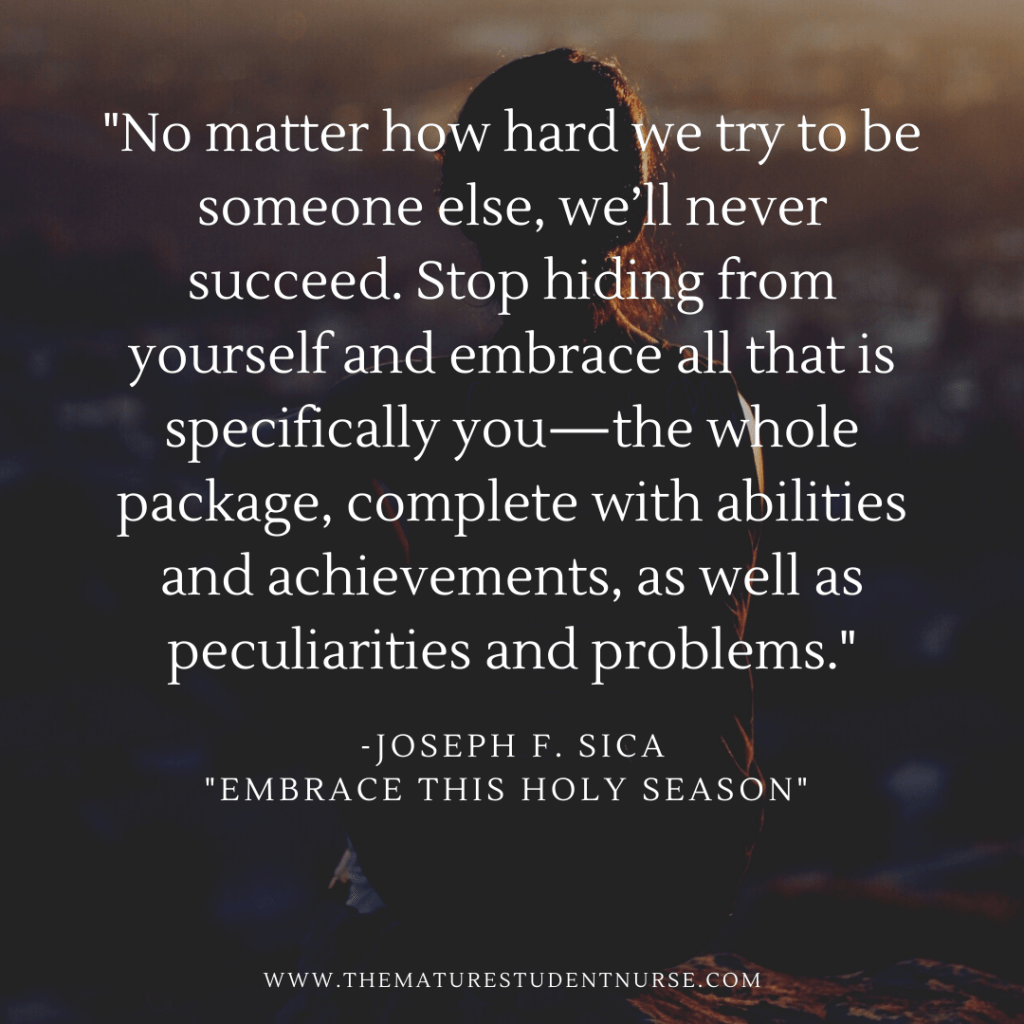
My first reminder came in a reflection from a 2021 Lenten devotional I’ve been reading, “Embrace This Holy Season” by Joseph F. Sica. In the February 22 entry entitled “Getting Past the Past,” Joseph F. Sica shared:

“When you find yourself being drawn back into the pain and negative experiences, choose to focus on the present—on what is happening right now—and recognize that history is history. To get past your past, you need to accept it as it was and leave it there. Then pay deliberate attention to this moment—a time that’s never been before and is loaded with opportunities and possibilities. All you have to do is seize them.”

He then offers the helpful practice of taping the following quote to a mirror: “Never look back unless you’re planning to go that way.” It reminded me of the retreat speaker sharing the story about driving using one’s rearview mirror. While I wouldn’t suggest NEVER looking back, don’t be fixated on life’s rearview mirror.

My second reminder came in an email from Marie Forleo, an entrepreneur. She was talking about her relationship with her husband and shared the following:

“Human minds are wired to scan for what’s wrong, especially when it comes to our significant other. We criticize, correct, and attempt to control them. We’re quick to judge and point out (either in our head or out loud) what’s not working. My suggestion? Stop that ASAP. Where attention goes, energy flows. Make a commitment to keep looking for what’s right about your partner. Focus on what they did do, who they are as a soul, and what’s wonderful about them — then proactively and verbally acknowledge that to them consistently.”

While Marie Forleo was talking about relationships, her statement about energy going where our attention flows applies to life, in general. We can focus on mistakes we’ve made in the past, our shortcomings, or we can focus on our strengths and continual improvement. As someone starting over in my career, I need to acknowledge when I do things right because it is easy for me to self-criticize when I do something wrong or not exactly how I would have liked. I’m still learning and developing as a novice nurse, and I need to give myself some grace.

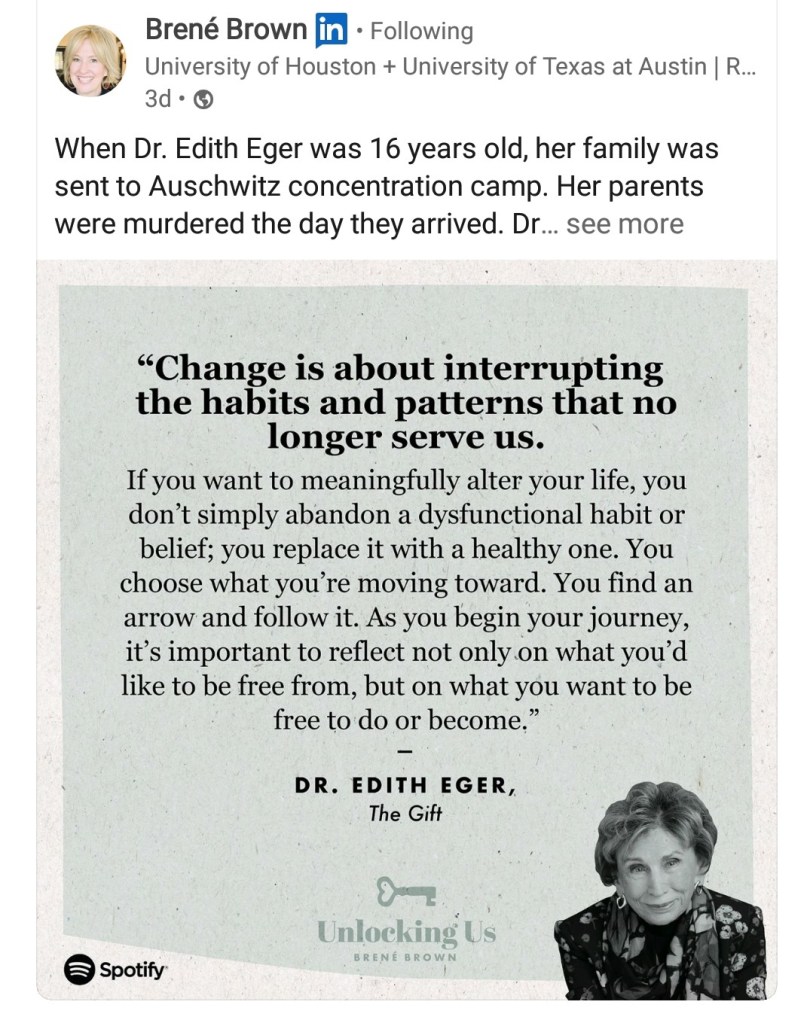
Finally, my third reminder came from Brene Brown, a researcher who focuses on shame and vulnerability. She has a podcast and had a guest, Dr. Edith Eger, discuss “Recognizing the Choices and Gifts in Our Lives.” Below is a quote from Dr. Eger that caught my eye while I was on LinkedIn:

I love the concept of finding an arrow and following it. We can’t move forward without an idea of our destination. Otherwise, we’re just wandering. If I make mistakes, after attempting to correct them, I need to know how to prevent them from happening again or improve myself. I’ve lived long enough to come to an understanding that God will present me with the same lesson over and over until I learn from it. Without a path to move forward, we may end up in circles.

Maybe you, too, needed gentle reminders to focus on moving forward. Perhaps you need to acknowledge your gifts and talents instead of dwelling on your shortcomings. Learn from your mistakes and move onward. Envision what you want, be assured of yourself, and head in that direction!

COVID Mass Vaccination Clinic and Lenten Encouragment

This past week was a little whirlwind filled with holidays, starting with Valentine’s Day, followed by President’s Day, Mardi Gras/Fat Tuesday, then Ash Wednesday. I worked the early part of this week at a mass vaccination site in LA County. It was the first time I had the opportunity to administer the COVID vaccine in my job. I was glad to be of service to so many in the community and happy to network with so many nurses.

It was tiring to be out in the sun, on my feet all day, in a stadium parking lot to either observe patients or give vaccines. Despite my achy feet and slight sunburn, I was grateful to contribute to the vaccine clinic. Patients were appreciative to get the vaccine. Amidst the 4,000 people we were vaccinating each day, I saw an old co-worker and friend I hadn’t seen in 3 years since I left my previous career to become a nurse. I took it as assurance that I am where I’m supposed to be, even if I’m still searching for a new grad hospital position. I also met experienced nurses who gave me suggestions and offered help in getting me a hospital job. I took that as a blessing and another sign that I’m where I’m supposed to be. The other nurses and I worked as a team and got to know one another. While supporting the community and each other, we enjoyed the perks of beautiful weather, stadium views over our lunch breaks, and food provided by the event organizers.

Fat Tuesday lunchtime views with my complimentary cheeseburger.

After a long day of work on Wednesday, I attended Ash Wednesday mass virtually at home. Ash Wednesday marks the beginning of the Lenten season. In his homily, my pastor exclaimed, “Don’t let a good pandemic go to waste!” It’s a strange thing to say, perhaps, but it offers guidance. Now, more than ever, we can slow down and not lead such hectic lives. I don’t have the excuses I once had about my pre-pandemic schedule being busy. My family and I can’t go to parties, attractions, museums, restaurants, bars, or friend’s homes like we used to. Instead of running around with our schedules filled, we can choose to spend time in meditation, prayer, or reflection. We can (re-)connect with others and build relationships using the technology available to us. (I’ve recently discovered the app, Marco Polo, and highly recommend it for connecting with others via private video messages)! I want to use this pandemic and Lent to re-focus on my spiritual well-being.

One of the things I’ve decided to do for Lent is to meditate or reflect on scripture each day. Luckily, my church is offering a daily devotional for parishioners to use during Lent, “Embrace This Holy Season” by Joseph Sica. I have enjoyed it so far.

On one of the days I had off from the vaccine clinic, I had my car serviced. I decided to pack my Med-Surge review book with me along with my devotional and bible. (I’m reviewing the Med-Surge book to prepare for an upcoming interview). The bible and “Embrace This Holy Season” were for me to complete my daily Lenten commitment. While the dealership serviced my car, I went for a walk, grabbed a coffee, and found an empty bench for me to study and meditate. I hadn’t taken time for myself like that in a very long time; it was glorious!

When I was a younger adult, I disliked the solemnity of the Lenten season. I appreciated the focus of prayer, fasting, and almsgiving, but it seemed like such a dark time. Now that I’m older, I appreciate the preparation Lent is for Easter. Lent is like a “time-out” for me to focus on my spiritual practices.

The Lenten reflection from Joseph Sica’s book for the day was about being ourselves and loving ourselves. I found it inspiring and a great reminder. I share parts of the reflection here with you, in case you need to read/hear it, too:

Some of you may not be Christian or observe Lent. Regardless, I encourage you to take time for yourself every once in a while for reflection or meditation. Create time for peace and quiet, if you can. Some of you have gratitude journals or practice hygge. This Lent, I commit to daily meditation and reflection. Even if you don’t observe Lent, maybe consider what you can do to make the most out of this pandemic. “Don’t let a good pandemic go to waste!” Can you use this time apart from others to gain clarity? Can you practice self-acceptance and appreciation? I love to hear how others practice self-care or self-love during this pandemic! Good luck on your journey!

Struggling With Boundaries and “No”

I know it’s been a while since I’ve posted. I feel like I’ve been struggling lately and don’t know what words of inspiration to provide. I find myself working when I didn’t plan to work to please my boss. I recognize that consistently not holding the boundaries I set for myself is unhealthy and causes suffering and resentment. Establishing and maintaining boundaries is a skill I have yet to master. I don’t know if I’d even call myself competent.

Sometimes I find myself working extra shifts, not because I want or need to, but because I want to keep my boss happy. I want her to give me a good recommendation when I put her down as a job reference. (I work as a COVID tester but am looking for an acute care RN role). However, when I work extra days to please my boss, it costs me a chance to recharge myself, spend time with family, job search, or blog. For example, even though I said I was unavailable to work the day after my second-dose COVID vaccination, I found myself working when I didn’t plan on it because my boss was short-staffed and begged me to work. My arm was sore, and I was tired and achy, but I had no other symptoms, so I obliged her plea for me to work. I had hoped to be taking it easy at home the day after my vaccination to fill out my daughter’s complicated kindergarten applications and other job applications for myself. Instead, I wore myself out by working the day after my second shot. By the time I got home, I felt so fatigued that all I could do was shower and lie in bed all evening. I couldn’t even pick up my daughter from her preschool; my husband did. My boss asked me to work again the following day (a day I usually have off), and I said I could not; I felt like I was fighting the flu! I found myself to the point of exhaustion before I finally said “No,” to my boss.

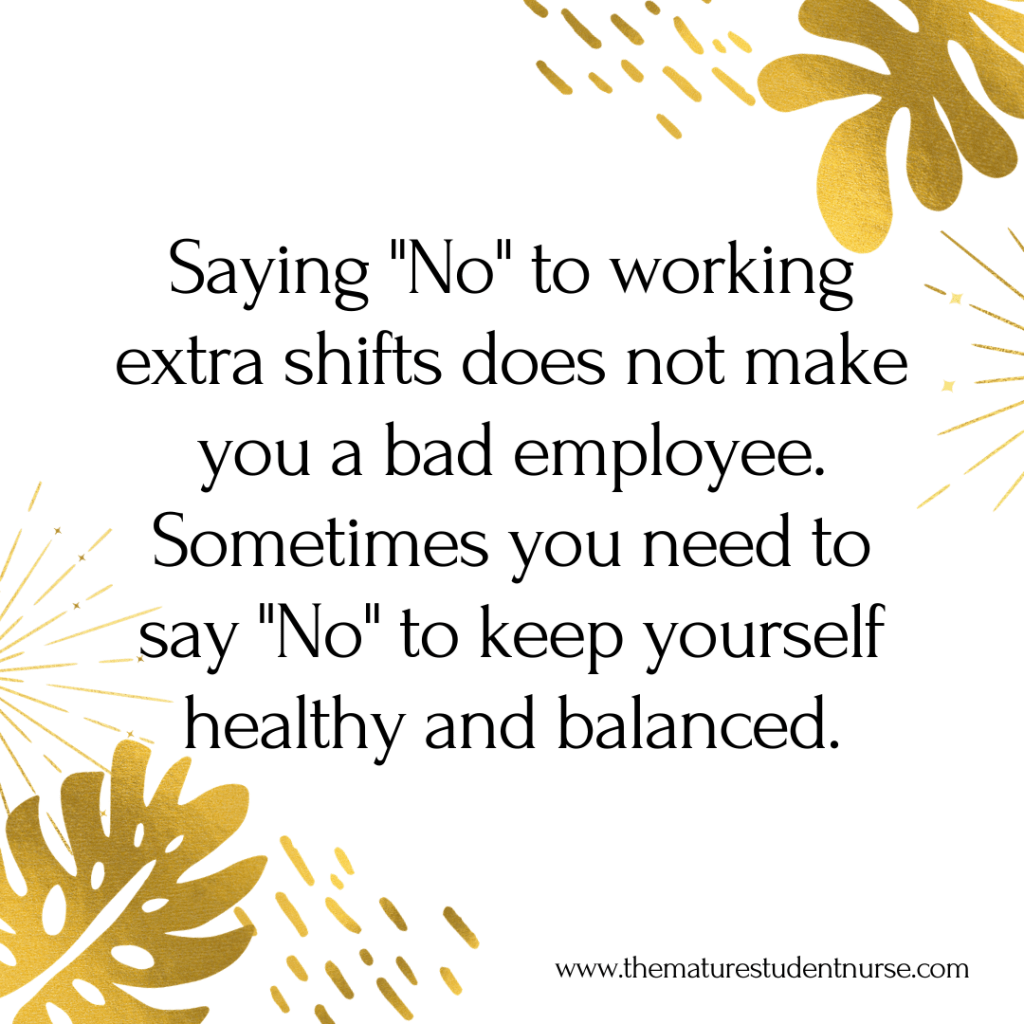
Being short-staffed seems to be a common theme no matter where a nurse works. (There are so many memes about this!) I am not a bad employee if I tell my boss I am not working extra days. Saying “No” is a skill I know I must strengthen to maintain the boundaries I set to keep myself healthy and balanced. [Un]Fortunately, it looks like I will have plenty of opportunities to practice saying, “No.”

Before I became a nurse, I was the type to cram a lot into my schedule. I still am this way. Usually, I enjoy it, but sometimes it’s stressful, especially when running late from event to event. However, since marrying my husband and having my daughter, I’ve been conscious of my family’s schedule and try not to burden them with too much activity. A nurse- and mom-friend told me her life coach suggested she schedule no more than three things in a day. I’ve been good with this for my family, but I am trying to uphold this goal for myself. I accomplish goals I set for myself more efficiently, and I am more satisfied and less overwhelmed when I create a manageable schedule.

I still have many goals and lots of things I feel I need to do or accomplish each day. Fortunately, I realize 1) I do not need to do everything all at once, and 2) Some things (like working or blogging) may fall off my schedule to focus on completing other things (like job and kindergarten applications). Honestly, I should make one of my goals to stop being such a people-pleaser, and I would be able to say NO guilt-free and struggle less. I am working on this, so thanks for your patience during my mini-break from blogging the past week!

Vision Boarding in Quarantine

Due to an unexpected quarantine from my daughter’s exposure to a COVID positive person, I found myself stuck at home for two weeks in January with my husband and daughter. Thankfully, all of us remained asymptomatic and tested negative for COVID. However, I adhered to the health recommendations to quarantine, and I did not work or leave the house outside of medical appointments for 14 days. Homebound, I decided to make my 2021 vision board a fun, creative activity I could do with my daughter.  

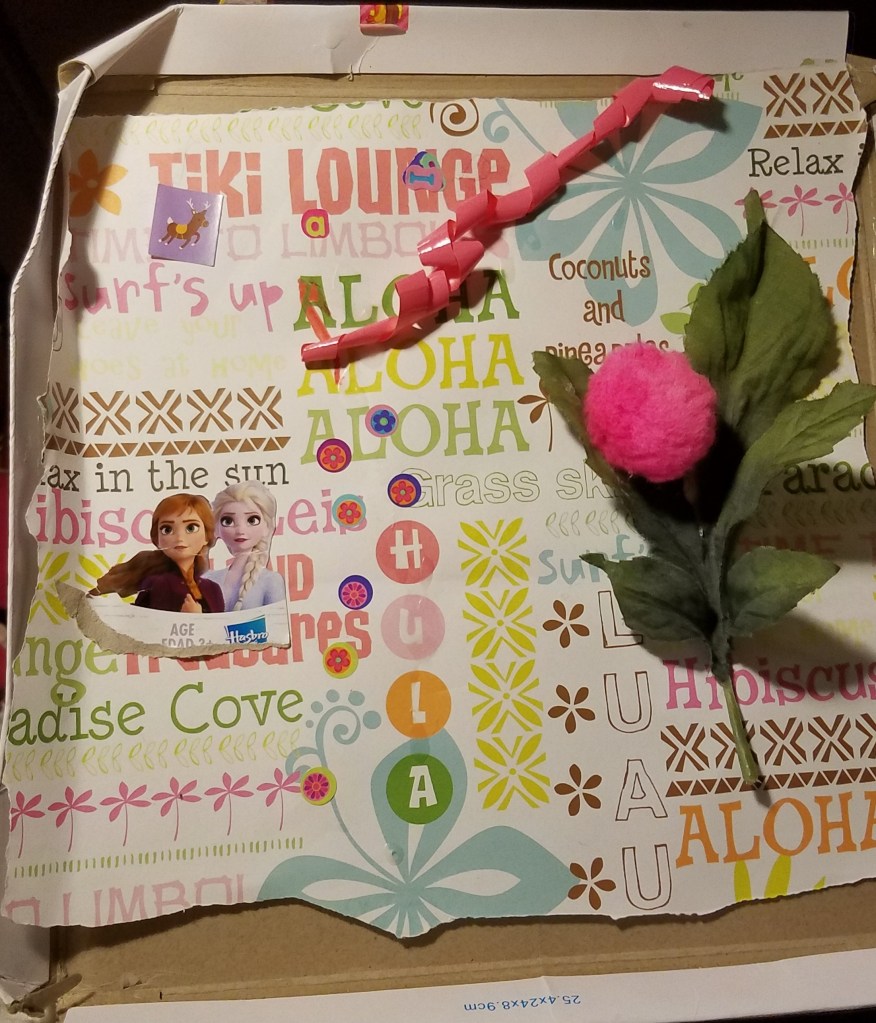
Below is the result of crafting together that day. 

My vision board / collage
My preschooler’s collage

I tend to be a visual learner and have found vision boards to be powerful tools. I’ve shared this before, but years before I became a mom, I made a vision board about being a parent. My husband and I spent over a year trying to get pregnant before I had a miscarriage. I eventually became pregnant with my daughter almost a year after our loss. It was pretty amazing to look back at that vision board, even though my dream of motherhood took some time to materialize. 

If you want to try your hand at making a vision board, below are some tips:

  1. Review your goals or vision board from the prior year (or semester or quarter). Reflect on what you’ve accomplished and acknowledge your achievements! 
  2. Do you have any remaining goals that will continue into the next year (or another timeframe)? Do you need to remove some obstacles before you’re able to achieve these goals? Consider removal of a barrier to be an initial goal.
  3. Think about your goals for your specified timeframe (year, semester, or quarter). What plans do you have for various areas of your life? You can focus on several areas of your life or many, but here are some to consider: work/career, finances, personal relationships, health/fitness, spirituality/well-being, education & development, rest & relaxation, or hobbies & fun.
  4. Are your goals S.M.A.R.T. ? S = Specific, M = Measurable, A = Achieveable, R = Realistic, T = Time-bound. If not, design them to be S.M.A.R.T.
  5. After you’ve thought about your goals (I also recommend writing them down in a planner or calendar!), gather supplies: paper, scissors, tape, glue, markers, and items with images you can use in your vision board (magazines, calendars, catalogs, or Pinterest photos/pins). 
  6. Start cutting out and collecting images or words that inspire you or remind you of the goals you have set for yourself. 
  7. Get at least one photo of yourself to place on your vision board. I also included pictures of my family in mine.
  8. Assemble your vision board, making sure to include the year or goal timeframe (e.g. Semester I 2021) and a photo of yourself!
  9. Place the vision board in an area you frequently see. I made my 2020 vision board and hung it on the wall by my desktop all last year. I replaced it with my 2021 vision board this month.

Before I made my 2021 vision board, I reviewed my 2020 vision board (per step 1 above). I posted my board last January on my FB and IG pages:

Upon review of last year’s vision board, it was reassuring to see how many things I accomplished or goals I achieved, despite a worldwide pandemic and various stay-at-home orders: 

  • The photo of a mom and her newborn in my vision board was a nod to my much-anticipated maternal newborn and pediatric rotations. I got to attend an emotionally moving c-section birth as part of my maternal newborn clinical rotation last year. My classmate and I witnessed a father cry with overwhelming joy and love for his newborn child – it was so sweet that my classmate and I were both moved to tears. I got to complete my preceptorship in a NICU. I had wonderful experiences during my rotations.
  • I had a bunch of images related to nursing, education, and graduation. I graduated from nursing school with my BSN and passed my NCLEX last year. 
  • I have “RN” and a pile of money on my board. I started my first job as a Registered Nurse before the year ended. 
  • I have travel luggage, a camera, vacation views, and photos of families having fun doing various physical activities on my 2020 board. My family and I managed to squeeze in two family vacations last year – one to Solvang (thanks to a good friend’s timeshare) and another to Bishop (as a result of tagging along on my husband’s business trip). We did not travel the way I originally envisioned after graduation, but my family enjoyed ourselves and explored new places while safely adhering to health orders.
  • I have images from “Hamilton”, the musical. I had tickets to watch the musical in-person with my husband at the Pantages in May. The show was canceled due to the pandemic. Luckily, our theatre tickets were refunded. I had to be satisfied (but “I will never be satisfied!”, a la Angelica Schuyler) watching it on Disney+. A benefit with watching the musical at home is that my daughter gets to enjoy it, too. My daughter periodically requests Alexa to play the songs, particularly the ones sung by any of the Schuyler Sisters.

Before the pandemic, I was excited to be part of the graduating class of perfect vision, 2020. I remember being a total dork and declaring this to my classmates well before the pandemic became a reality. After the pandemic started, I forgot about being part of the class of perfect vision. Earlier this year, however, my church’s mothers’ ministry had a Zoom meeting challenging members to think about how 2020 was the year of perfect vision. It was interesting to consider: I had to be laser-focused in my commitment to my goals to avoid distractions and overcome the obstacles of an unexpected pandemic. And maybe 2020 had me re-focus and let go of attachments and what I thought my life should look like. My family did not travel to other states or countries for vacation as in previous years, but we got to experience adventure and explore new places locally and within the state. My daughter speaks fondly of Solvang as much as she does of Spain (we visited in 2019). Even with letting go of attachments and expectations of what I thought things should be like, I didn’t accomplish all my 2020 goals – I still need to add more physical activity in my life and to declutter my home – but looking at my old vision board, I’m proud of what I’ve accomplished in 2020! Now, onward to 2021!

MLK Career Inspiration

Today is Martin Luther King, Jr. day in America, where we celebrate and remember this great activist. Most people are familiar with Martin Luther King Jr.’s (MLK) “I Have a Dream” speech but may not be aware of his other speeches or the origin of some of his inspirational quotes. He was a great preacher and gave many more rallying and inspirational speeches promoting justice, non-violence, and people’s dignity. One of his speeches that inspired me in my career and career change was “What Is Your Life’s Blueprint?” I wasn’t aware of this speech or its contents until I attended a performance at my work years ago where someone had assembled parts of MLK’s speeches and presented/recited it for us during an MLK day celebration. I was lucky to have an active African American employee resource group host the presentation over lunch at our company.

Martin Luther King, Jr. presented “What Is Your Life’s Blueprint?” to a group of students at Barrat Junior High School on October 26, 1967. It is a timeless message that is relevant today and applies to all ages about being the best you can be. Footage from that day and video of his entire speech can be found on YouTube at https://youtu.be/kmsAxX84cjQ, thanks to The Martin Luther King, Jr. Center for Nonviolent Social Change. In honor of the holiday, I encourage you to watch the footage, which is only about 20 minutes. Below, I have gathered some motivational quotes and excerpts from his speech that were not previously familiar to me. I hope you reference them whenever you need inspiration!

Keep striving for excellence as you pursue your future endeavors, whether it be nursing or otherwise! Have a blessed day!