After I graduated in 2020, a friend once asked me if I would change my blog’s name since I was no longer a nursing student. I explained that while I’m no longer in nursing school, nurses must constantly learn and seek information like students. Nurses must update their license by taking continuing education courses and obtain or maintain certifications by regularly taking classes. Nursing processes or protocols are derived from evidence-based practices, which result from studies and research. With innovation and advancing technology, employers will require additional training or buy new equipment or software that nurses must learn how to use. There will always be something new to learn as a nurse.
I’m grateful for the classes during my orientation and training in my new grad program. My employer is taking the time to teach me and build my skills and knowledge by offering classes to supplement my preceptorship. My orientation classes are online (asynchronous or synchronous) or in-person. Often, the live, synchronous classes require pre-work before meeting with the instructor. However, we had a real-time virtual simulation earlier this week without pre-work requirements. There was no homework, but my takeaway from simulation this week is that I should review some of our policies or algorithms for specific situations. Taking classes does not make me an expert, and I’d rather be familiar with equipment and policies than floundering and doubting my actions in actual emergencies.
Overall, my new grad program classes are a good review and make me feel more confident and prepared as I shift and work with patients. Another resident in my cohort joked that we didn’t have to go to nursing school because our program taught everything we need to know as nurses! Regardless, I appreciate the review and the thoroughness of my training.
As healthcare providers, it is essential to remain curious and acknowledge we do not know everything. No one is perfect, and there is something to learn from mistakes and failures. Being a student implies a commitment to learning and continued growth and development. May we all be open to discovery and education regardless of one’s industry, profession, or age. Take on the mind of a student!
I was inspired by a quote I saw in a post about life not being easy:
“Marriage is hard. Divorce is hard. Choose your hard.
Obesity is hard. Being fit is hard. Choose your hard.
Being in debt is hard. Being financially disciplined is hard. Choose your hard.
Communication is hard. Not communicating is hard. Choose your hard.
Life will never be easy. It will always be hard. But we can choose our hard. Choose wisely”
-Author unknown
I don’t know who authored the original quote, but I thought I’d add my own spin on it.
Also, I want to tell you something I tell my daughter (and myself) : “YOU CAN DO HARD THINGS”.
I am my daughter’s first and foremost female role model. How she sees me react to struggle or hard things makes an impression on her. I am not perfect. I struggle and often make mistakes. However, I want my daughter to see me handle difficult things and be resilient. She needs to know it’s okay to try again after failure or to continuously attempt hard things. The best way to teach her that is through my own actions.
Life isn’t easy. We don’t always have easy or favorable choices. We often have hard choices. But our resiliency and how we handle hard choices is what shapes us and makes us stronger. Know you’re not alone.
I graduated from my Accelerated Bachelor of Nursing Program! Until about a week ago, I was busy with finals and organizing my cohort’s virtual pinning ceremony. However, TODAY, my school finally posted that I officially conferred my Bachelor of Science in Nursing degree on August 08, 2020!
Class of 2020 BSN Graduate!
I graduated, but there were MANY people who made this possible!
Like many in my cohort, I feel God lead me to the nursing profession. Through constant prayer and faith in God’s plans, I arrived at this point in my life. I was able to move forward in my path toward Nursing because of God and the people and circumstances God placed in my life.
In my virtual pinning ceremony (*a pinning ceremony is a nursing school tradition to celebrate the completion of the program where graduates are pinned with a lapel pin – often their school’s emblem), I dedicated my pin to my husband, daughter, and parents. My husband and daughter have sacrificed time with me and their schedules to accommodate my classes, studying, and clinical rotations. My parents often volunteered to watch my daughter so I could study, and they would visit and offer to help with dinners, dishes, laundry so I could focus on school. Nursing school was a journey my entire family shared, and I can’t imagine graduating without their love and support.
I consider myself lucky to have had such generous and collaborative classmates. Instead of competing with one another, we worked together to create study guides and study sessions. Life would have been considerably harder without everyone’s contributions and kindness in my cohort.
I was also blessed to have another mom in my program. I discovered during orientation that she was my neighbor! We became carpool buddies and, eventually, close friends. Being a nursing student in an accelerated program is tough – balancing school with kids in a pandemic makes things even trickier. We both understood and could commiserate in our unique struggles.
I want to acknowledge the teachers, instructors, and school staff for making it possible for students to continue learning. It was not necessarily easy for students to move exclusively to online lectures and have their schedules changed, but I recognize it was not easy for those teaching and supporting students as well. I’m very grateful for our instructors for being flexible and making themselves available. Some of our clinical instructors were on-call and taught us over the Summer when they initially planned to guide us in the hospitals in Spring. Our administration also hustled to place all the nursing students in rotations when many hospitals canceled their preceptorships. When the pandemic started and we were pulled from our clinicals, we were in limbo. If we were unable to return to the hospitals to complete our clinical hours, we would not graduate. After going through all the clearance requirements at one hospital, our instructors, alongside the students, scrambled to complete clearance requirements at other hospitals finally open to students. Despite the obstacles, a pandemic, and a revolution, we managed to graduate on time!
Doing nursing school in 15 months while being a mom was no easy task, but I’m a testament to the fact that it is possible! I had a LOT of support – including friends and family who prayed for me, guided me, and encouraged me along the way. Form your support system if you don’t already have one. Life’s too short to spend time with people who bring out the worst in you! Your journey and timeline may not look like mine, but I encourage you to pursue your passion and dreams. I was the oldest student in my cohort, but I have a lot to offer, and I intend to work as a nurse for multiple decades. It’s cliche, but it’s true: You are never too old (or young) to pursue your dreams!
I know many are starting school this Fall. I wish nothing but the best for the students returning to school and those taking steps to move closer to their goals. These are uncertain times, but I applaud all those adapting, reorganizing themselves, and moving forward. Good luck to everyone this new school year, and CONGRATULATIONS to all the 2020 graduates!
My major milestone this past week was completing my first IV blood draw on a patient, during my ICU rotation. My nurse guided me. I stuck the patient with a butterfly needle and was able to draw blood on my FIRST try! 💉(Luckily, my patient had a really nice big, palpable vein).
My nurse and I walked into the patient room, she handed me the supplies, told me to go ahead, and began charting. I was lost and told her I needed her supervision. I had seen a nurse draw blood from a patient line the week before, so I thought I was going to take blood from an existing IV line. My nurse stopped me when she saw that I was about to sanitize a peripheral IV port. My nurse looked at me like I had three heads 🤔. I worried I wasn’t going to be allowed to do the skill anymore! She explained blood is never drawn from a PIV. The blood draw I saw was from an arterial blood line. I hadn’t realized blood draws are not taken from PIV lines; in retrospect, it makes sense not to draw from a line where a patient received meds.
Despite my nurse’s obviously concerned look, my nurse patiently guided me and let me continue. She repeatedly commented how she was astonished I hadn’t done an IV needle stick on a patient before. I was totally nervous and felt judged, but I knew I had to take my opportunity to practice such an essential skill of getting a needle into a vein. I’ve practiced many times using IV catheters in the skills lab on mannequins, but it’s not the same as inserting IV needles into humans.
LESSON 1: Speak up when uncertain about how to do something. At the very least, talk through the steps BEFORE walking into the room. While our patient’s primary language was not English, it would have been better to have the conversation that I had never drawn blood on a human and discuss the expected process OUTSIDE the patient room. It’s stressful enough being a patient in a hospital; I don’t want to raise a patient’s concerns about me or my abilities with the procedures I’m about to perform.
LESSON 2: Talk out loud while completing steps in a process. While I’m still new and learning, talking out loud helps to reinforce what I’ve learned and the expected process. This applies to any skill, even medication administration (i.e. “…clamp the NG tube…insert syringe…unclamp…push syringe…clamp, etc). Verbalizing steps helps me confirm what I should do or stop myself when something sounds incorrect or strange. Also, my nurse or instructor can hear me as I do things, and guide or interrupt me as needed.
Last week, I also spent more time in my Pediatric rotation. 🧸I’m really loving my Pediatric (Peds) clinical rotation and feel drawn to the particular hospital and patient population. However, I recognize I need more practice feeling baby pulses, particularly pedal ones 🦶. I can usually find pulses quickly on adults, but I find babies’ pulses harder to palpate. I eventually felt the pulses on my infant patients, but it took me a long time. My nurse would feel a pulse and point me to where “it’s a good pulse”. I’d put my finger on the location, and feel hardly anything. I may have been pressing too hard in trying to feel a pulse. I gotta ask my mom friends if I can feel their baby’s pulses to practice this skill – at least it’s not invasive so it should be relatively easy to practice. I often practice assessments on my family and myself, but my daughter is now a toddler – I just need access to more BABIES!
On my volunteer shift in the Emergency Room recently, I (along with many other staff members) overheard a heated discussion between a male patient and one of the charge nurses behind patient curtains. The patient was trying to clarify he wasn’t demanding a white nurse, but that he insisted on having an older female nurse. He did not want the black male nurse assigned to him. After the charge nurse explained his request would not be granted, he passionately responded that he wanted someone with more experience; to him, that implied an “older” nurse. The charge nurse assured him that his nurse had many years of experience. The patient assumed his nurse would be a woman because he thought all nurses were women. He argued he had been to the hospital numerous times and proclaimed, “I’ve never had a male nurse!” After some back and forth, the patient confessed he didn’t want a man handling his penis to insert a urinary catheter.
The whole interaction was interesting to me because I am an an older nursing student. When I become a new BSN grad, I will have relatively little experience but will be older than many new graduates. Age does not correlate to relevant work experience or skill-level. Many working nurses I encounter while volunteering may be younger than me, but have many more years of nursing experience. This patient erroneously believed an older nurse would automatically have more expertise in a common procedure than a young nurse.
The encounter was not only an example of ageism, but sexism. Yes, there seems to be more female nurses than male nurses. The patient was adamant that he never knew male nurses existed. The patient was an older man, so it’s quite possible his earlier experiences with nurses in a doctor’s office or hospitals were with female nurses. The demographics are changing, however, and quite frankly, I think that’s a good thing. We need healthcare professionals to be as diverse as the patients they serve. This patient needed a gentle reminder that experience, not gender, make nurses more skilled at procedures.
The black male nurse eventually did what needed to be done for the patient. A while later, the man graciously reported to the charge nurse, “He did a great job!” The patient continued to loudly and excitedly share what a surprisingly wonderful experience he had with his nurse. The same staff that overheard the earlier conversation and I looked at each other and smiled in amusement. Happily, it was a great teaching moment for the patient, but also for myself.
I’ve read about patients getting discriminated against or experiencing implicit bias from their providers, but healthcare professionals also experience discrimination from their patients, and the interaction I witnessed was a reminder of that. I have yet to have a patient make discriminating remarks directed towards me, but I know that may happen one day. I’m not quite sure how I’ll react, and I wonder if I’ll learn anything about this in my ABSN program. I want my patients to have the best experience and outcomes possible, but does that mean I should ask to be removed from their case if they don’t like me and are therefore uncomfortable due to my race, age, gender, or orientation? In accommodating a prejudiced patient’s request, are we enabling discrimination or giving them better care by making them comfortable? It’s a complex issue.
Luckily, the interaction I witnessed de-escalated and had a good outcome. What if the patient became more hostile instead of agreeable? Would he have been assigned another nurse? What if the patient thought his nurse did a terrible job? Are there hospital policies for situations like this? I really respect the charge nurse and nurse in the situation, who remained professional and respectful throughout the whole interaction. For me, I learned how a nurse should respond to a prejudiced patient: Be respectful but firm, and assure the patient they are in good care. I hope to maintain my composure and act the same way, should I ever encounter a similar situation with a patient.
I went to church Sunday morning with my family and saw the devotional booklet “Our Daily Bread” offered in the vestibule. I hadn’t seen one in a while, but became familiar with them through my mother and relatives from the Philippines, who used them regularly as a daily devotional. The booklet highlights a bible scripture each day and provides a reflection based on that reading. Feeling like I needed to focus more on my spirituality beyond church (it’s so hard sometimes to focus in mass with a rambunctious defiant toddler!), I grabbed one. The bible passage and reflection for that day (April 28, 2019) spoke to me. Because of that, I wanted to share it and invite you to read it at https://odb.org/2019/04/28/gods-retirement-plan/# .
At this moment in your life, what might God be calling you to do for His greater purpose? What new plans has He placed in your path?
Our Daily Bread (April 28, 2019)
The reflection was a great reminder of my second-career journey. Becoming a nurse is the new plan God has placed in my path. I feel I am called to become a nurse to better utilize my talents for His greater purpose. Do you ever feel like you’re on the right path because of the all the “signs” God places before you? You may not have the sign of a burning bush like Moses, but do you feel called to do something, even though you’re uncertain of how exactly you’ll accomplish what you sense you must do? Are you continuously driven towards a vocation without knowing how or if you can really make it happen? And, somehow, a path reveals itself? I feel this way about Nursing – really, I do!
Every step of the way, I feel like God has aligned things for me to allow me to get into Nursing school. If I had waited even one month to look into pre-requisites, I wouldn’t have been able to take the classes I did or complete them before the application cycle. If I had waited one week before researching how to get volunteer clinical experiences, I wouldn’t have become a COPE Health Scholar in a local hospital. If I were in a different volunteer program, I wouldn’t have been able to take patients’ vitals, witness biopsies, circumcisions, C-sections, vaginal deliveries, or perform chest compressions on patients who have coded. God placed people and experiences in my life, to allow me to grow in my compassion, abilities, and skills as a future nurse. Somehow, things aligned or confirmed and re-affirmed my choice to purse a career change. God placed the desire in my heart to consider nursing years ago, but He did not call me into action until now -when I have the social, emotional, and financial support I didn’t have before. His timing was perfect. I prayed to be able to serve God in whichever way He willed, and nursing is where I have now been lead. I have a peace and joy in my heart when I think about my [future] career, but I am still open to God’s vocational plans for me in my life.
Are you called to something new or to continue when you were about to quit? I encourage you to be open to new possibilities or to where God might be calling you. Explore what or where that is, and if you’re called to act, pursue it whole-heartedly. Like Dr. Warwick Rodwell discovering the ancient statue in the Lichfield Cathedral in the “Our Daily Bread” reflection, you could be surprised with the treasure you uncover.
When I decided to become a nurse, I researched various nursing schools and programs and quickly discovered before I could even apply or be eligible to attend a program, I needed to complete pre-requisites (classes required BEFORE Nursing school entry). The nursing programs I considered required anywhere from 7-12 pre-requisites. Common pre-requisite courses include Anatomy and Physiology (with lab), Microbiology (with lab), and Chemistry. However, some schools require Public Speaking, Ethics, Religion, or other courses unique to their program.
While some schools take into consideration courses completed as part of a bachelor’s degree, other nursing schools do not accept any courses if they were not completed within the last 5 or 7 years. So even though I took numerous chemistry classes as part of my Chemical Engineering degree, since it was greater than 5-7 years ago, I had to retake chemistry! Overall, while I was annoyed at first, (re-)taking chemistry was helpful because it introduced me to some cool classmates and teachers and provided a nice review to help prepare me for the TEAS (more on that in another post!).
It is CRITICAL for applicants to know what schools and specific programs they wish to attend because pre-requisites vary – even within the same school – across different programs. As I shared, I took Chemistry with Lab at my local community college to satisfy a pre-requisite requirement for a state university. However, the community college offered two different Introductory/General Chemistry courses and some nursing programs require the Introduction to General Chemistry course instead of the Introductory Chemistry course. After spending an entire summer in Introductory Chemistry lecture and lab, my lab partner discovered the course we completed was not eligible as a pre-requisite to her desired nursing program. The community college guidance counselor had told her that the course was accepted at her school of choice. Even the course description for our chemistry class stated “This course is designed for Nursing and other Allied Health majors”. Unfortunately, when the class ended, my friend discovered that her program did not accept the chemistry class we worked hard to complete.
She called me in a panic when she learned of the news because I planned to apply to the same school. My heart stopped when she told me – I had spent so much time researching the classes I was taking and ensuring they counted as pre-requisites – could I have been mistaken? My ability to apply to nursing programs in the Fall was contingent upon the completion of my carefully scheduled pre-requisites. After some back and forth, we discovered the accelerated BSN program at the state university accepted the chemistry course we completed, while the traditional BSN program (at the same school!) did not. I felt terrible for her. Fortunately, she did well in our class, so her GPA was not adversely affected, and I’m sure the knowledge she gained will only help her when she takes the other General Chemistry course. She shared she was in no rush to apply to nursing programs, so having to take an extra chemistry class did not affect her plans too much.
Unlike my friend, I couldn’t afford taking classes that did not count as pre-requisites. I was working hard to complete as many pre-requisites as possible in order to apply to Nursing programs by Fall 2018. It was tricky and definitely not easy, but I completed thirteen pre-requisites within a year while either working or volunteering. I got accepted into three different accelerated Nursing programs, so my hard work and meticulous planning paid off. Below are some steps that I recommend and used myself to navigate what pre-requisites to take for nursing:
Step 1: Identify the specific nursing programs in which you are interested in applying.
Knowing where you plan to apply dictates which pre-requisites to take and possibly when to take them. Many programs will not allow you to apply unless you complete all science pre-requisites. Some programs will allow you to apply without completing pre-requisites so long as you show progress that you will complete the rest of the pre-requisites before the program begins. However, even if you can apply to programs without completing all pre-requisites, having more pre-requisites completed (and obviously doing well in them) makes you a more attractive applicant than others who have not completed their pre-requisites.
Step 2: Understand the pre-requisites for each nursing program and list them in a spreadsheet
I listed all the programs in which I was interested and listed all the pre-requisites required for each program. Like a typical nerd-engineer, I created a spreadsheet with this information. By doing this I was able to quickly identify which program had the least or most requirements and which programs had overlapping pre-requisites. I also used the same spreadsheet to compare program costs, duration, and other entrance requirements. It gave me a good overview that I could reference periodically.
a snapshot of my pre-requisites spreadsheet
Step 3: Before taking a class, check with your prospective program if they accept the class as a pre-requisite
Of course you can take pre-requisites from the college or university which offers your prospective nursing program. Doing so guarantees that your program will accept your pre-requisites. To save money, however, many opt to take their pre-requisites elsewhere, such as a community college. Or, some students, like myself, may need to take pre-requisites at a college that offers evening and weekend classes to accommodate work or family schedules. If you take a class offered elsewhere than the college where your nursing program belongs, ensure the classes transfer and can count as pre-requisites for your program.
Some colleges have links or list what classes they accept to fulfill pre-Nursing requirements. Others will allow you to specifically contact them to ask if a class meets their requirements. Contact the program administrator or director to inquire if they accept a class as a pre-requisite. Be prepared to share the accredited school’s name where the class is offered, the course name and number, the number of units, and course description. You can also follow this process to verify if any previous course you completed counts as a pre-requisite.
I recommend verifying pre-requisite equivalency and printing out proof of this for each class taken as a pre-requisite. Sometimes equivalencies change, but at least you’ll have evidence that the class you took was considered equivalent when you took it. Plus, doing this for myself gave me a quick reference and peace of mind in moments of doubt and panic (like when my friend contacted me about our chemistry class).
TIP: Keep your pre-requisite syllabi. My Anatomy & Physiology II professor recommended keeping syllabi from all my pre-requisites. Luckily, I didn’t have to resort to using any past syllabi, but having syllabi is helpful to have on-hand in case your prospective school wants to review a class you took and needs more than the general catalog description.
TIP for Californians: Use http://www.assist.org . It’s a helpful website “that shows how course credits earned at one public California college or university can be applied when transferred to another”. If you plan to apply to public college or university in California for your nursing program, you can verify if the pre-requisites you are taking at a California public college/university are accepted by your program.
Step 4: Determine where and when the classes are offered, and create a corresponding class schedule
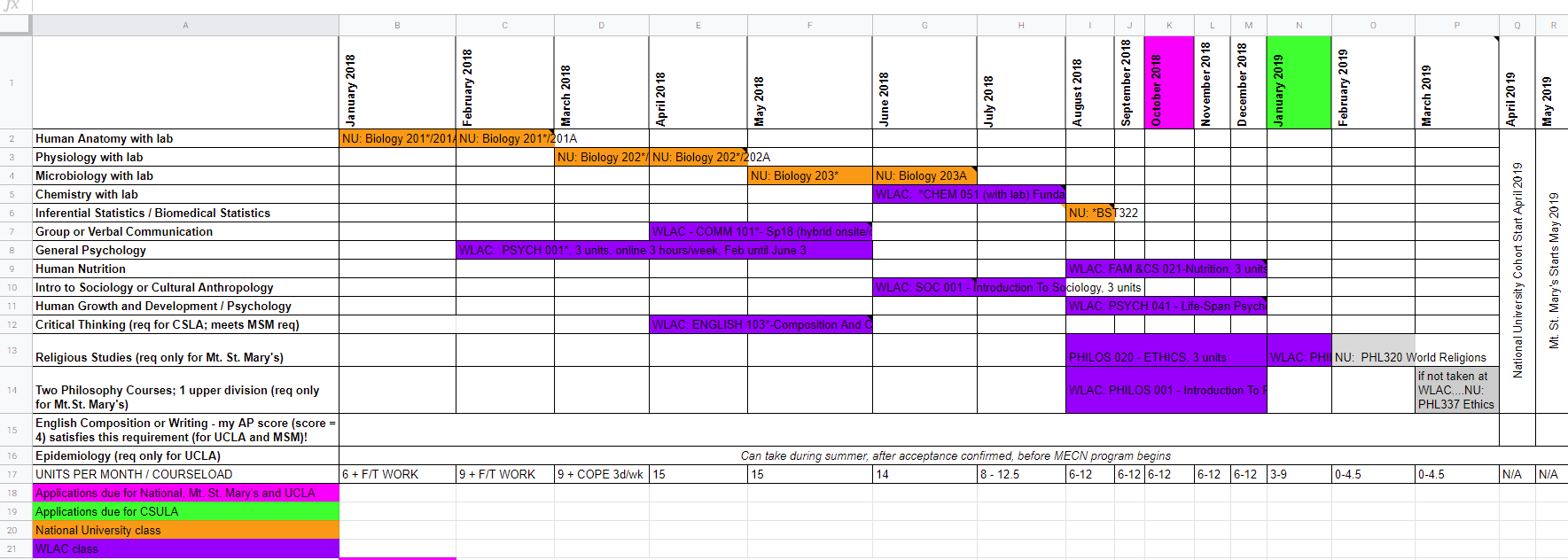
I created a GANTT chart outlining when certain classes were offered and the schools that offered them. This was important in realistically understanding the earliest I could apply to nursing programs and how much it might cost me to complete all the pre-requisites. I knew I wanted to complete 13 pre-requisites in one year, but not all classes are offered throughout the year nor do they perfectly stagger with one another. I had to figure out if I could take classes online (some nursing programs do NOT accept online courses for certain pre-requisites), which schools offered the courses I needed, and when my schedule would allow me to take in-person classes.
After considering my budget and schedule, I limited myself to taking pre-requisites at my local community college and at National University. Both are great options that I recommend to others. At the community college, I appreciated knowing exactly what courses transferred from the college to other state schools via assist.org and the extremely affordable tuition. Some community college courses even used free online textbooks! At National University, I liked the small class size, that each course was only 1-2 months, the evening and weekend schedules for in-person classes, and the fact that most all my classmates were pre-Nursing. In addition, most of the National University students had worked before or were currently working, so could appreciate pursuing Nursing as a second-career.
I evaluated each of my pre-requisites and figured out when they would be offered at either the community college (preferred, cheaper choice) or National University (approximately 10 times the cost of community college courses). Some classes offered at the community college (Anatomy & Physiology) required pre-requisites (Biology), so it was easy to choose National University for such classes. Using the GANTT chart, I calendarized each pre-requisite class I planned to take, the school offering the class, and the specific discussion section(s) I wanted, once the class schedule became available.
My GANTT chart for Nursing Pre-Requisites
Step 5: Execute according to your planned schedule, and adjust as needed.
As soon as I was able to register for classes, I immediately enrolled prior to the semester, quarter, and/or month. I never had a problem getting into the classes I needed. (Although, a friend shared whenever she had the issue of being wait listed at her community college, she would still attend class and eventually get enrolled). I also captured the anticipated nursing school application deadlines in the GANTT chart, so it would be clear which pre-requisites would be completed before applications were due.
By creating my GANTT chart, I could get a sense of my anticipated course load throughout the year and see where my classes overlapped. I was able to see that I had the opportunity to take the Chemistry class earlier than I originally planned as well as some Philosophy courses (pre-requisites unique to one program). Instead of taking Chemistry in the Fall semester, I took it in Summer. This allowed me to squeeze in an extra Philosophy class in the Fall and gave me a good review of Chemistry before taking the TEAS in November. (TEAS TIP: Completing your pre-requisites before the TEAS makes TEAS preparation easier)!
Due to work and my overall schedule, more often than not, I ended up taking condensed courses. Even though National University offers classes that are only 1-2 months in duration, the community college also condensed classes. Classes normally a semester long were only 4-6 weeks when I took it. I would not have purposely scheduled my pre-requisites this way, but 1) it allowed me to complete thirteen pre-requisites in only one year, and 2) this prepared me for the rigor I will likely experience in my accelerated Nursing program.
While my schedule was rigorous, I had the full emotional and financial support of my family. With their support and understanding, I was able to study enough to get A’s on my pre-requisites while either working or volunteering in a hospital. My undergraduate GPA barely met minimum Nursing school requirements, so I knew I had to do well in my pre-requisites to stand a chance in getting accepted into any prospective programs. With God’s grace and a lot of hard work and effort, I was able to excel in my pre-requisite courses which helped me get into several accelerated Nursing programs.
Overall, you will need to decide what you can or cannot handle and what resources you need to stick to your schedule. Keep in mind that many nursing programs will not consider applicants with C-grades for their science pre-requisites. Additionally, accelerated nursing programs are extremely competitive, so having a good GPA on pre-requisite courses is advantageous. Maybe you’ll need to cut back on work hours or find childcare to give you time to study. If neither is possible and you’re drowning in schoolwork and unable to do well, perhaps consider a lighter course load. Not only do you want to complete the correct pre-requisites, you want to do well in them, so adjust your schedule accordingly!






 The Mature Student Nurse